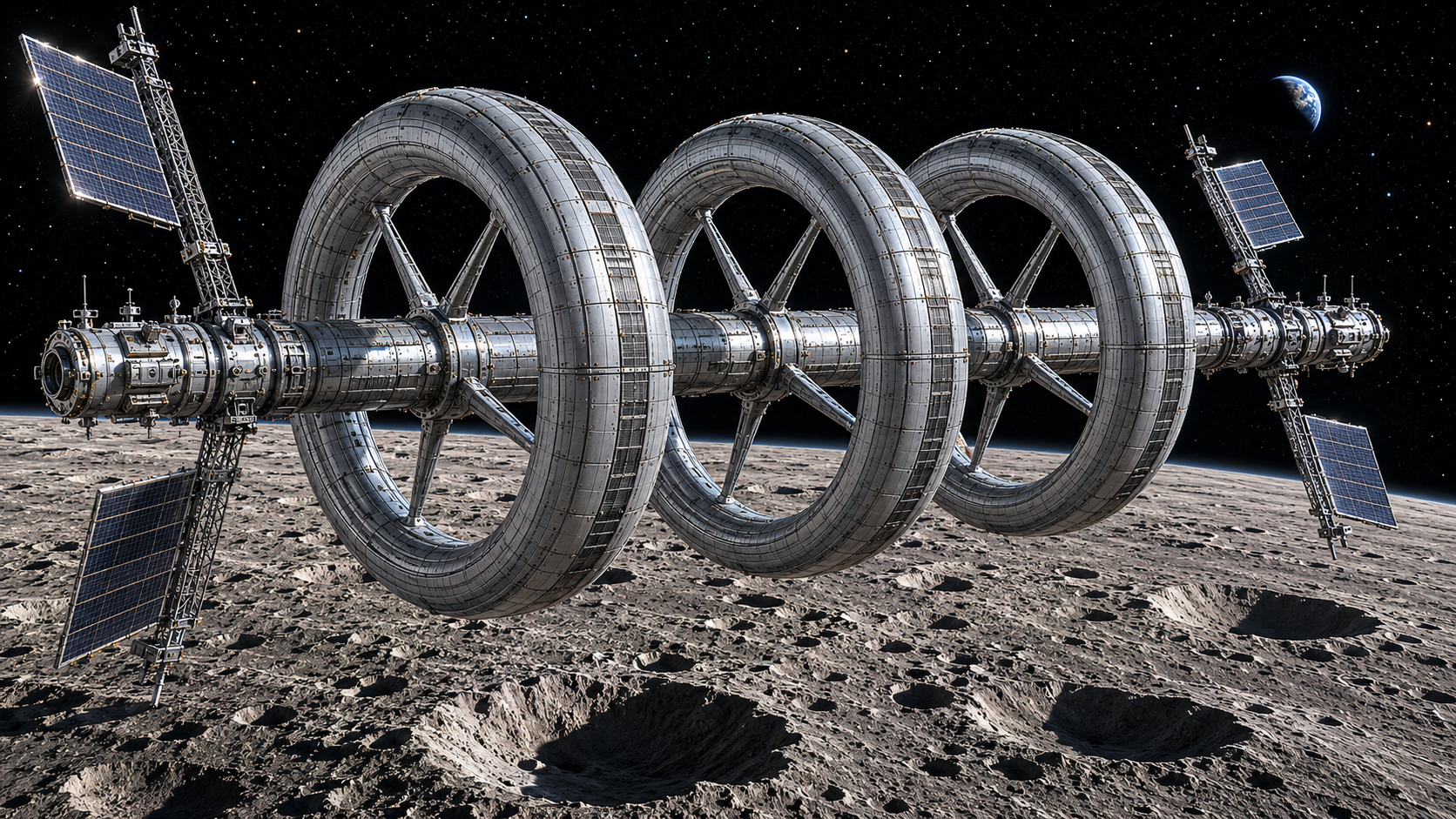
The most common pushback on Aegis Station is some version of the same question: wouldn’t a single large-diameter ring be more stable, less prone to tumbling end over end, than a stack of three? It’s a good question. It’s usually the first one a careful person lands on, and the instinct behind it is sound — you want the configuration that holds its orientation and doesn’t drift its way into a slow failure. The short answer is that stability doesn’t actually depend on ring count, and a compact co-rotating stack turns out to be a steadier configuration than one big thin ring anyway. The longer answer — the part worth a whole note — is that stability was never the reason there are three.
01What the question assumes
The question assumes the number was chosen for performance. That somewhere there was a trade study sweeping ring count against mass and stability, and three fell out as the optimum. There wasn’t. The physics that governs spin stability is real and it matters, and at the stage where Aegis Station is being built for real it will be settled by people who do rotational dynamics for a living — not argued out in a comment thread. That’s true of most of the hard parts. The station will take structural engineers, fluid people, radiation people, life-support people, all sharper in their domains than any one architect. The job at this stage isn’t to out-physics them. It’s to make the decisions that set the constraints they’ll work inside, and to make them for reasons that hold up.
Three rings is one of those decisions. And the reason isn’t a number that came out of an equation.
02The reason
Three rings means three physically isolated pressure vessels — separate life support, separate thermal loops, separate atmospheres. A catastrophic failure in one ring is contained to that ring. It doesn’t cascade. The crew evacuates to an adjacent ring and the station survives the loss of a third of itself.
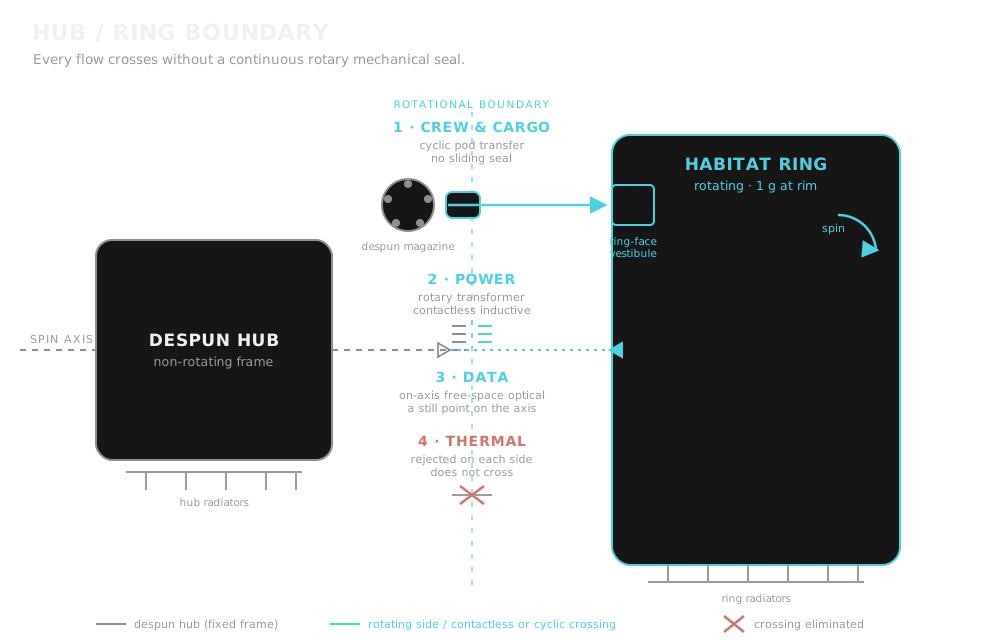
The honesty matters here, so here’s the limit: the rings aren’t fully independent. They share the hub. The hub is the one genuine single point of failure in the architecture, and no amount of ring-counting makes that go away. What three rings buys is everything downstream of the hub — the parts where people actually live. A long way from home, you want somewhere safe to go.
03Where it gets satisfying
The part that makes the design feel right, rather than just defensible, is that the survivability reason and the physics happen to agree. The compact co-rotating stack that’s the steadier configuration is also the one that gives you isolated failure domains. There was no trade — no compromising the physics to get the redundancy, or the redundancy to get the physics. The shape that holds the station steady is the same shape that gives the crew somewhere to run.
That isn’t luck, exactly, and it isn’t cleverness either. It’s what happens when a single hard constraint does the deciding. The constraint is that there’s no rescue and no resupply on any useful timescale. When the environment is that unforgiving, the survivable architectures and the stable architectures tend to collapse onto the same answer, because the only designs that make it are the ones where those reasons already agreed.
04The number
So three isn’t an optimization result. It’s a statement about what’s owed to a crew that can’t come home on short notice: more than one chance. Everything technical — the spin dynamics, the structure, the hub that still has to be solved — is downstream of that one decision, and most of it will be solved by people who haven’t joined the project yet.
That’s the reason there are three. Three chances, a long way from home.