Aegis Station · Program Architecture
Building the first permanent world in lunar orbit
Dry-orbit assembly and in-situ resource utilization as core principles.
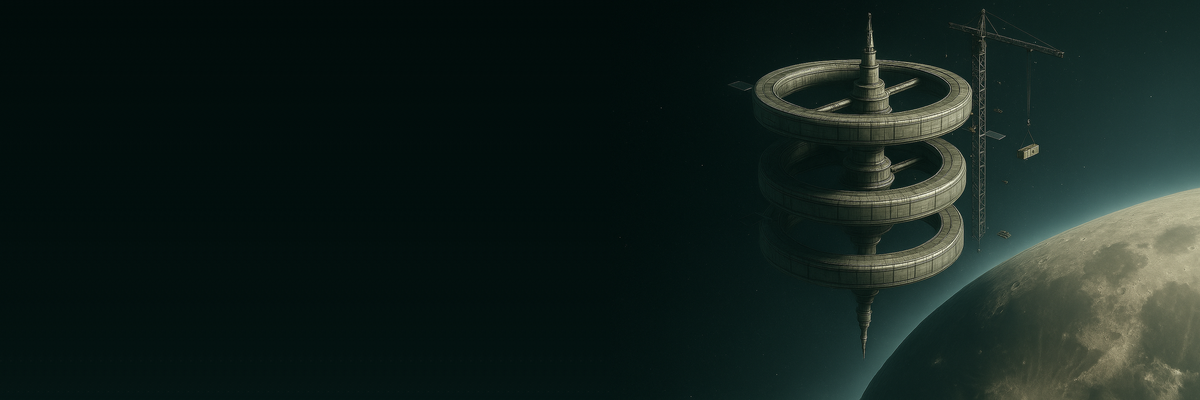
Aegis Station is a modular, rotating habitat constructed in lunar orbit. Rather than launching a fully assembled station or supplying shielding water from Earth, the Aegis approach is built around dry-orbit assembly and in-situ resource utilization. Components arrive unshielded and are assembled in place; water for radiation shielding is sourced entirely from the Moon.
This approach avoids Earth-orbit traffic congestion, reduces launch costs by eliminating heavy water mass from the manifest, and positions Aegis Station as the operational hub of a permanent lunar supply chain from day one.
Heavy-lift delivery of dry components; orbital transfer via the Long-Hauler fleet.
Heavy-lift vehicles deliver dry modular components directly to lunar orbit. Each launch manifest is optimized for a discrete structural or systems package.
Modular crew and cargo vehicles handle orbital transfer between Earth and the Moon, supporting both construction phases and ongoing operations.
Robotic assembly in stable 100 km lunar orbit.
Assembly takes place in a stable 100 km circular lunar orbit. The sequence is axis-first: central hub modules are connected along the station spine before ring construction begins. Each ring is formed from 8 arc segments, robotically maneuvered and locked into alignment with sub-centimeter tolerances. Utility systems — power, fluid routing, data — are integrated at the segment level before full ring closure.
Spin-up and life support activation follow only after structural and systems verification of the complete ring assembly. No habitation occurs in an unverified segment.
Lunar-sourced water delivered at scale by a dedicated tanker fleet.
Each ring's outer hull contains a 3-meter-thick water layer providing radiation shielding for the crew inside. All water is sourced from lunar polar ice — extracted, processed, and delivered to orbit by the Aegis tanker fleet. No shielding mass is launched from Earth.
Tanker operations begin in parallel with structural assembly. Partial shielding supports early crew operations before full fill is complete, with shield depth tracked per-segment and risk managed against occupancy schedules.
Phased activation from first ring to full three-ring operations.
Operational approximately 18 months from construction start. First pressurized, inhabited ring. Spin-up to 1g and life support systems activated following verification.
Follow at 12–18 month intervals after Ring 1. Each ring adds crew capacity, redundancy, and operational volume. Full three-ring configuration reaches design complement.
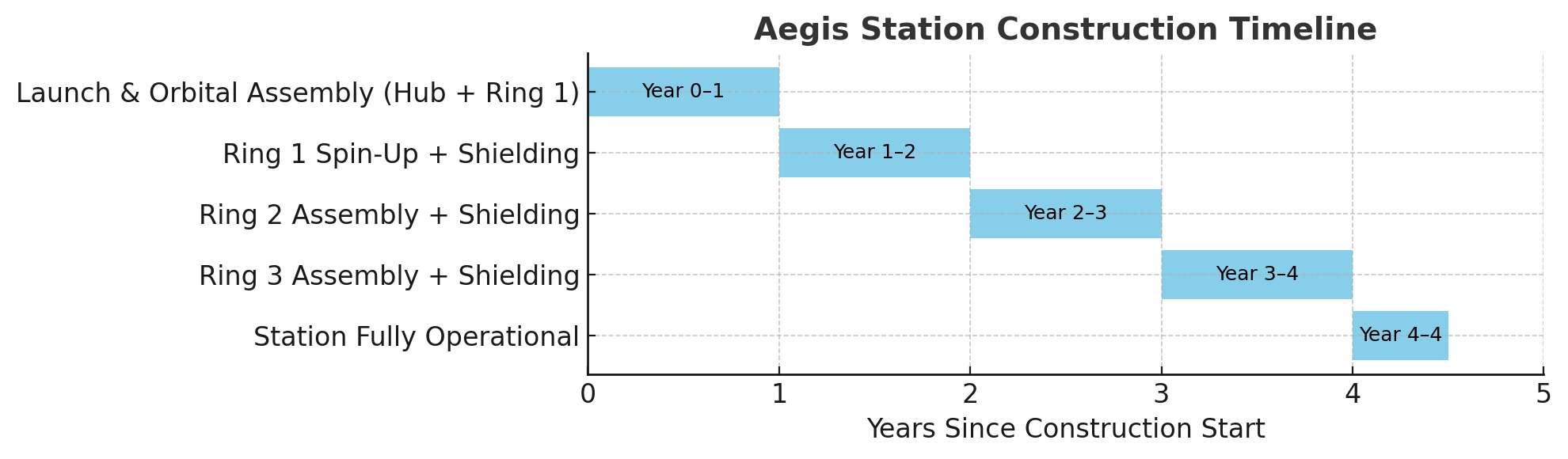
Construction timetable — from first component delivery through three-ring activation
Construction assets transition directly into operational infrastructure.
No construction asset is retired at completion. Long-Haulers, tankers, and assembly tugs transition into operational roles — supporting maintenance cycles, shielding top-off, crew rotation, and future expansion. The logistics chain built to construct Aegis Station is the same one that sustains it.