Aegis Station
Hub/Ring Boundary
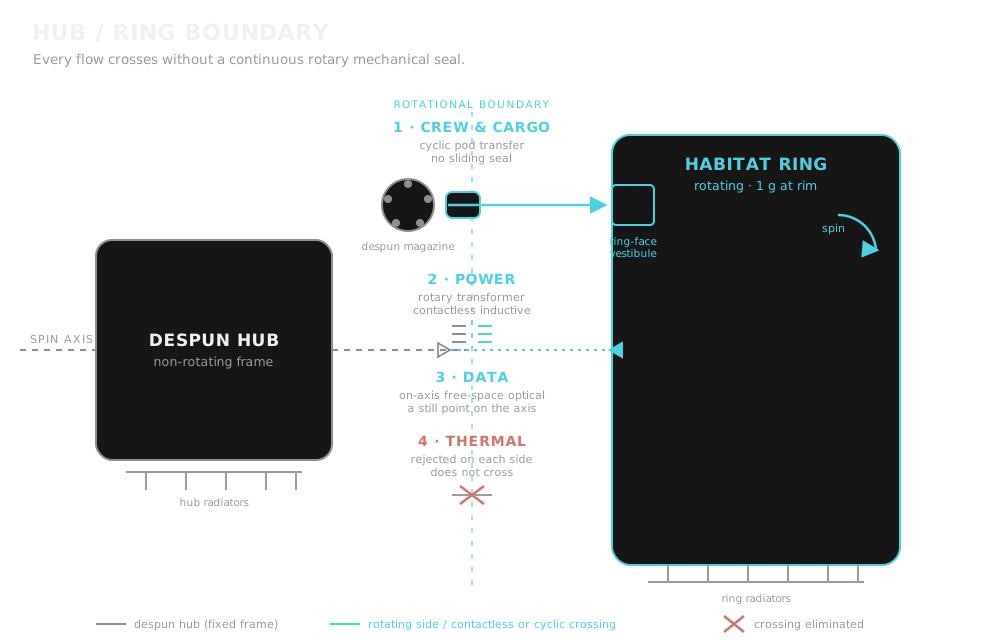
The hub/ring boundary is the interface between Aegis Station's despun central hub and its three co-rotating habitat rings. Everything the station needs to move — crew, cargo, water, power, data, heat — crosses this boundary. The architectural principle is singular: no continuous rotary mechanical interface carries a life-critical flow. No slip rings. No continuous rotary fluid seals. Every crossing is either contactless, cyclic, or eliminated entirely by distributing the function across both sides.
1. Design Principle
Continuous rotary mechanical interfaces — slip rings, brush assemblies, rotary fluid unions — are the historically failure-prone elements of rotating space systems. Wear, contamination, seal degradation, and single-point failure modes have driven substantial operational problems on existing platforms. Aegis Station eliminates them at the hub/ring boundary.
Each flow across the boundary is handled by the mechanism best matched to its duty cycle:
- Cyclic mechanical transfer for crew, cargo, and bulk fluids — carried by standardized pods through despun magazines and ring-face vestibules.
- Contactless coupling for power and data — rotary transformers for power, free-space optical links for data.
- Function distribution for thermal and selected utilities — heat is rejected on the ring directly; the ring carries its own independent services where doing so is cheaper than crossing the boundary.
The hub becomes an interface bus, not a utility umbilical. The rings are substantially autonomous systems connected to the hub through a small number of well-characterized, well-behaved crossings.
2. Crew Crossings
Crew cross the boundary inside transit pods — pressurized, seat-equipped vessels with independent life support, moved through a cyclic transfer mechanism that never requires continuous relative motion between a sealed pressurized volume and a rotating structure.
Transit Pod
- Common ~3.5 m external envelope; 4 crew nominal, 6 crew contingency evac load
- Independent ECLSS with ~24-hour endurance at nominal load
- Per-seat LEA-class pressure suits with umbilical-compatible interfaces
- Manual hatch operation — no power, no comms, no software in the safety path
- Pod long axis aligns with station spin axis; "floor" points outward from hub centerline
Despun Magazine
- Disc carousel co-located with each ring face; diameter just exceeds hub outer wall
- Five pod berths arrayed around rim, rotation axis parallel to station spin axis
- Loads despun from hub-internal corridor; spins up to ring rate for transfer
- Reaction wheels absorb spin-up/down torque; water ballast compensates partial-load asymmetry
- Contactless relationship with ring during spin-up; no seal is slipping under pressure at any phase
Axial Transfer
- At co-rotation, pod is pushed axially forward into a ring-face receptacle
- Both sides are at the same radius and angular rate — the transfer is a simple linear motion in the rotating frame
- No rotary fluid or gas seal is traversed; pressure mate occurs between two co-rotating surfaces
- Mechanism is bidirectional for pod retrieval
Ring-Face Vestibule
- Pressurized volume on the ring's inner (hub-facing) surface where pods mate
- Crew disembark in low-g; take ring-internal lifts outward to the rim habitat level
- Pod stays at the boundary; no pod traverses the ring's radial depth
- Four vestibules per ring, distributed around the ring face for redundancy and walking-distance coverage
Sizing & Cadence
With a design complement of roughly 3,000–5,000 permanent crew distributed across three identical rings, per-vestibule peak load is well within the capacity of 5-chamber magazines operating on a scheduled ~15–20 minute cycle. Surge mode (~10 minute cycles) supports full-ring evacuation in under two hours without relying on any single vestibule.
Crew Safety Layers
| Layer | Function |
|---|---|
| Pressurized hub corridor & vestibule | Nominal shirtsleeve environment on both sides of the crossing |
| Pod hull & independent ECLSS | Sealed volume, hours of independent life support |
| LEA pressure suits, per seat | Pressure containment if both pressurized volumes fail |
| Manual egress & mechanical hatches | Power-independent exit to a pressurized refuge |
3. Cargo & Bulk Fluids
Cargo crosses the boundary by the same pod form factor as crew, in a parallel cargo-variant magazine at each ring. This eliminates continuous rotary fluid unions entirely — bulk water, pressurant gas, and other fluids cross as sealed cartridges, not as flowing streams through rotating plumbing.
Cargo Pod
- Shared external envelope and transfer interface with passenger pod
- Internal cradle accepts a single 45-tonne MTC, standard cargo modules, or outsize hardware
- Pressurized or unpressurized per mission; active thermal for sensitive payloads
- No life support; full internal envelope available for payload mass
Cargo Magazine
- Mechanically identical to passenger magazine; parallel hardware per ring face
- Scheduled independently of passenger cadence to avoid interference
- Can carry a passenger pod in contingency if a passenger magazine is out of service
Bulk Fluid Transfer
- Water for ring shielding arrives as sealed MTCs carried on cargo pods
- Cartridges discharge inside the ring at pressure-equalized dry transfer interfaces
- Empty cartridges return the same way for surface refill
- Pressurant gas uses dedicated gas cartridges on the same transit path — no rotary gas union
What This Eliminates
- No continuous rotary water line crossing the boundary
- No pressurant gas rotary seal
- No shared failure mode between fluid transfer and structural rotation
- Fluid seal life is no longer a station-level reliability driver
4. Power Crossings
Power crosses the boundary via contactless inductive coupling — a rotary transformer whose primary and secondary windings rotate relative to each other across a small air gap. No brushes. No sliding contact. No wear item on the power path.
Primary Power Path
- Rotary transformer at each ring interface; primary on hub, secondary on ring
- High-frequency AC link; efficiency in the high 90s is achievable at scale
- No contact means no contamination, no brush dust, no wear-limited service life
Ring-Mounted Generation
- Each ring carries independent PV and storage sufficient for core life support and essential loads
- Rotary-transformer path is primary; ring-mounted power is backup and peaking
- Ring can survive a complete hub-power outage indefinitely on its own generation and storage
No Slip Rings
- Slip rings and brush assemblies are excluded from the boundary architecture
- Historic rotating-power problems (brush wear, contamination, arcing) do not exist here
- Maintenance on the boundary power path is scheduled, not reactive
Fault Isolation
- Primary and ring-local power are independent circuits with no shared fault domain
- Transformer isolation inherently blocks common-mode faults between hub and ring buses
- Loss of any single ring does not propagate to the hub or to other rings
5. Data Crossings
Data crosses the boundary via free-space optical links on the station spin axis. The geometry is naturally favorable: an on-axis point is stationary in both the hub and ring reference frames, so no mechanical rotation of the link itself is required.
On-Axis Optical
- Redundant transceivers at the hub/ring interface, aligned along the station spin axis
- Bandwidth and latency sufficient for all station operational and crew traffic
- No EMI, no contact wear, no continuous rotary mechanical interface
Redundant Paths
- Each ring carries multiple independent optical transceivers for fault tolerance
- Low-rate RF backup for safing and initial reacquisition after outage
- Optical fiber paralleling the crew transit path provides a wired redundant route
6. Thermal Crossings
Most station waste heat does not cross the boundary. Ring-generated heat is rejected by ring-mounted radiators on the rotating structure. This eliminates the need for a continuous rotary fluid coupling on a working thermal loop, which would otherwise be one of the highest-duty-cycle and highest-consequence wear items on the station.
Ring-Side Rejection
- Habitat thermal loads are handled entirely on the ring by ring-mounted radiators
- Rotation geometry is compatible with radiator view factor management
- No thermal working fluid crosses the boundary in the primary path
Hub-Side Rejection
- Hub equipment heat is rejected on hub-mounted radiators, also without boundary crossing
- Small hub/ring coupling only via air exchange through pressurized transit corridors — a known, benign path
7. Boundary Summary
| Flow | Crossing Mechanism | Continuous Rotary Seal? |
|---|---|---|
| Crew | Cyclic pod transfer via despun magazine and ring-face vestibule | No |
| Cargo | Cyclic pod transfer via cargo magazine | No |
| Bulk water | Sealed MTCs carried as cargo pod payload | No |
| Pressurant gas | Sealed gas cartridges carried as cargo pod payload | No |
| Power | Rotary transformer (contactless inductive) | No |
| Data | On-axis free-space optical | No |
| Thermal | Rejected on each side independently | No |
The hub/ring boundary carries every flow the station needs without a single continuous rotary mechanical seal in any life-critical path. Cyclic transfers are bounded, well-characterized, and maintainable. Contactless couplings have no wear items. Functions that can be distributed across both sides are, removing the crossing entirely.
This page describes the boundary only. Ring-internal architecture, hub infrastructure, and overall station design are addressed elsewhere in the program documentation.
← Back to Home