Meteoroid Protection
Each of the station's three rings is a tube 100 m across with 3 m of water in its wall, and together they present two square kilometres to space, in an orbit 100 km above the Moon. This page is what strikes that wall and how often, what a spaced outer wall buys over a single skin of the same mass, and what a strike does to a wall with water behind it.
Behind it is a model with 58 checks against results known without it. The figures are drawn by the model's equations as the page loads, and the wall in section 3 can be fired at. Nothing here is built or tested, and one part of it, the ejecta from the lunar surface, rests on a 1969 model carried well past where it was meant to be used. That part is marked wherever it appears.
1. What strikes the station
The interplanetary flux at the Earth's distance from the Sun, less what the Moon hides. There is no orbital debris to speak of here, so meteoroids are the whole of the fast population. A space station's wall is designed against a particle of about a centimetre because its few thousand square metres will almost never meet one. This station's rings present two square kilometres, and they will.
The sky from 100 km
2. Ejecta from the lunar surface
Every meteoroid that strikes the Moon throws up many times its own mass, slowly. Almost all of it falls back within a few kilometres. A particle leaving at 45° needs km/s to reach the station's height, where it has slowed to a few hundred metres a second and the station runs into it at its own orbital speed, about km/s.
The only published flux law found is NASA's 1969 model (SP-8013), which gives the flux at the surface in three intervals of ejecta speed and was meant for use up to 30 km. The model here reads those intervals as one law, the count of particles faster than v falling as v to the power −, and follows each particle up its ballistic path to 100 km. By that reckoning the station meets about as many slow particles of a given size as fast ones.
Take the ejecta figures as a reason to look, not as a count. The law is carried to three times its stated height, on launch speeds at and beyond its fastest interval, with no largest particle, and lunar soil is mostly finer than a millimetre. Launched straight up there would be times as many, and at 60° from the vertical times. NASA's newer model finds SP-8013 high overall but low for speeds of 0.25 to 1 km/s, and is made for assets on the surface. If you know of an ejecta flux for a low lunar orbit, we would like to hear of it.
3. One wall or two
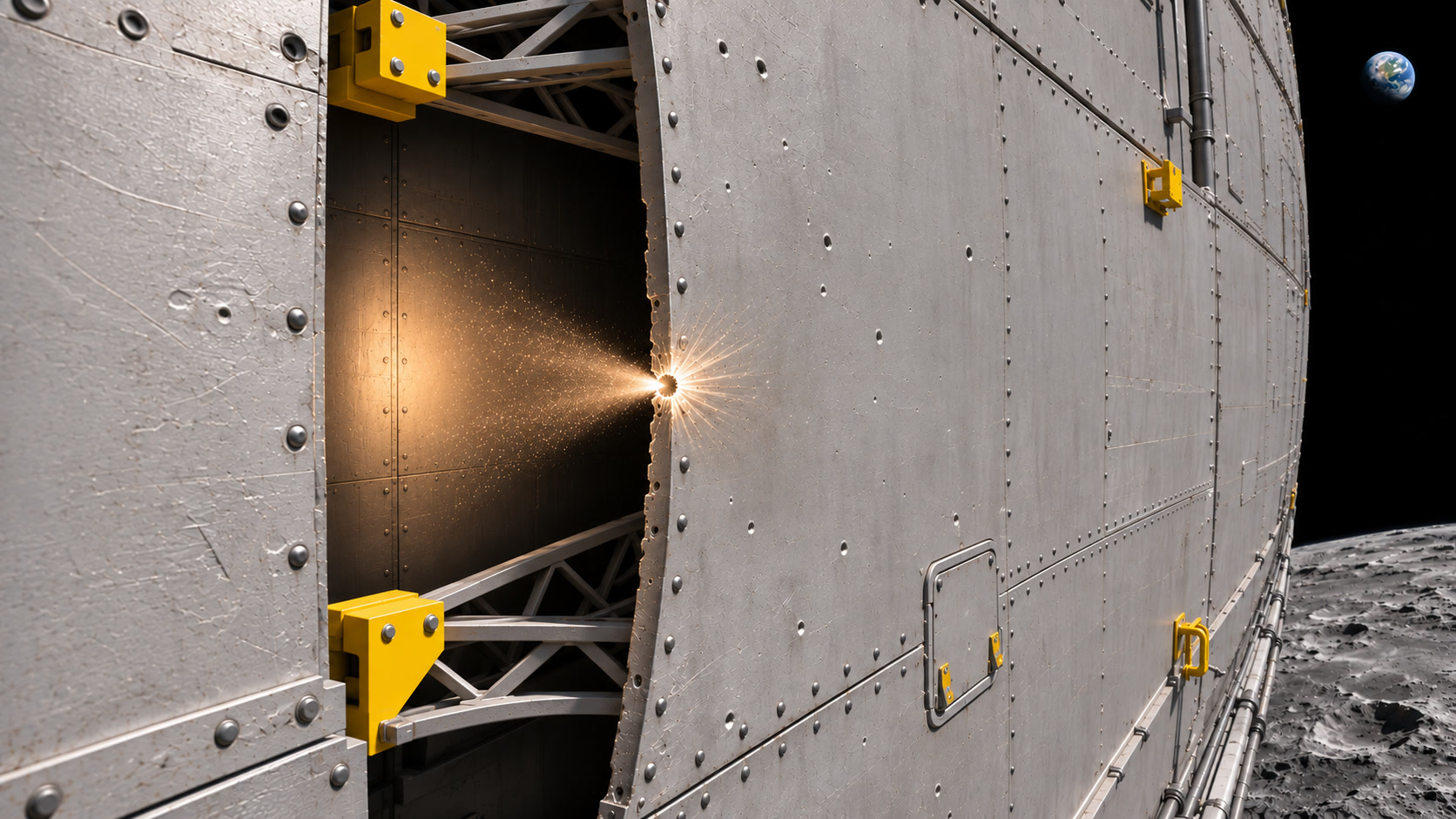
A particle at meteoroid speeds does not survive a thin plate. It and the plate's plug come out the back as a spreading cloud of fragments, melt and vapour, and a second wall some way behind meets that cloud over a wide patch in place of a point. The same mass of wall stops a particle several times larger when it is split and spaced. Fire a particle at the wall below, then change the wall.
The ballistic limit
The same mass four ways
Spacing the wall does nothing against the slow particles: they pass the bumper whole, and the two walls stop about what one plate of their combined thickness would. So the ejecta column is the same at every standoff, and past about 0.3 m it is what opens most cells. More standoff stops paying there. More rear wall, or a tough layer in the gap, is what moves that column.
36 kg/m² is what the ring's concept-level sizing allows for the wall that contains the shield water, and none is added. The frames that hold the bumper off are not counted. The equations are fitted to some 200 tests with particles to 1.9 cm, speeds to 8 km/s and standoffs of 3 to 140 particle diameters. At meteoroid speeds they are an extrapolation.
4. A cell opened to vacuum
Behind the outer wall is water, so a hole in it is a leak and not a loss of cabin air. The crew is not at risk from the hole. The ring's balance is: each ring's shield is in 40 segments, each with a trim range of 1 % of its water (rotational dynamics), and a hole the size of a finger spends that in days. A segment losing water is also an imbalance that grows, which the balance already reads from the hub's motion, so the station would know of a leak before anyone looked for the hole. Finding it is work for the hull inspection free-flyer.
Flow through a sharp hole, with no credit for ice forming in it. The two heads are a cell no deeper than the shield (3 m of water at about 1 g) and a shield with no divisions at all, top of the tube to the bottom. The shield's internal layout is open.
5. The energy, and the water
No meteoroid on any timescale that matters reaches the pressure hull as a body: 3 m of water is 3 t on every square metre, and a rock is stopped once it has swept up a few times its own mass. What can reach the hull is the shock. The table takes the largest strike expected in a span and puts all of its energy into the water as if it were explosive, 3 m from the hull.
An upper bound and not an estimate. The strike is at the water's outer face with vacuum behind it, so most of the energy leaves the way it came; the shield is in cells; and a bumper turns the particle to a cloud that arrives over a wide patch of wall. A strike carries a great deal of energy and almost no momentum (a 6 g particle at 17 km/s carries 100 N s), so what reaches the hull depends on how the energy is coupled to the water, and the spaced wall is what uncouples it. That is its second job here and possibly the larger one. * past the flux model's fitted range. † below the shock similitude's fitted range.
6. What follows, and what is open
The outer skin as a bumper
Split the containing wall's mass into a thin outer skin and the wall proper. On a 50 m tube the gap costs nothing. Cells opened by meteoroids fall from some sixteen a year to one in decades. Past about 0.3 m the slow ejecta is the larger count and more standoff buys little.
Default: spaced, 30 % of the mass outboard, about 0.3 m apart.
Tolerance, not prevention
Over two square kilometres and a century something of 1 to 2 cm arrives however the wall is built. The design case is a cell that can be opened, shut off, patched and refilled, and a count of how often.
Default: size the cells and their valves for a lost cell; count patches a year.
The balance as the leak detector
A 10 mm hole moves 30 to 100 t a day out of one segment. The balance reads imbalance from the hub's motion and would see it grow.
Default: a breached segment as a case in the balance model. Not yet run.
Slow ejecta from the surface
By the 1969 law carried up to 100 km, slow ejecta opens a cell about as often as meteoroids do through a well-spaced wall, and no standoff helps. The law is far outside its range here and could be wrong by orders either way.
Open: an ejecta flux in orbit. Until then, a higher orbit and a thicker rear wall are the two levers.
A wall with water behind it
The equations here are fitted to walls with nothing behind them. Water supports a wall against bulging and also carries the shock on. A 1970 SRI report for NASA (Gough) treated a water-backed wall behind a bumper and is the place to start.
Open: the rear wall's limit when backed by water.
What lies outside the bumper
The rim's tension members carry the spin load of everything in the ring. Anything of theirs left outboard of the bumper meets the whole flux, and strikes at a tenth of a millimetre come in millions a year.
Open: what is inboard of the bumper and what is not.
Not in the model
- Where on the Moon ejecta is thrown from, at what angles, and how large its largest particles are.
- Where meteoroids come from. The flux is taken as even over the sky the Moon leaves; in truth it is strongest from the direction of the Earth's travel round the Sun and from toward and away from the Sun. NASA's Meteoroid Engineering Model gives this for lunar orbit.
- The particle's density as a spread, and showers.
- The hub's wall, the spokes, windows, radiators, docks and the water cartridges in transit.
- Ice forming in a hole, which may close small ones.
7. What changed, and what this is
What changed. The spaced-wall equations first written into the model were an older set. Checked against NASA's 2003 report they were replaced with its own; the single-plate equation was already the report's. The newer set counts standoff for more and takes the bumper's thickness into account, and the model now gives the two ends of a curve in the report's own figure. The report prints one test, for a thin bumper, with two different powers of the standoff; the one that leaves the test without units is used.
What exists. A model in plain code: the meteoroid flux and its speeds at 100 km, the ejecta carried up from the surface, the two wall equations, the count of cells opened over every speed and angle of arrival, the leak, and the shock as an upper bound. 58 checks, among them that this page computes what the model computes.
What is a model. Everything. Nothing is tested, the wall's material properties are placeholders, and the results are conditions (if the wall is this, then this), not verdicts. The flux model, the speed distribution and the shock similitude have not yet been checked against their own sources as the wall equations have.
Sources. Christiansen, Meteoroid/Debris Shielding, NASA TP-2003-210788. Grün and others, Collisional balance of the meteoritic complex, Icarus 62 (1985). Cour-Palais, Meteoroid Environment Model 1969, near Earth to lunar surface, NASA SP-8013. DeStefano and Martin, The Lunar Meteoroid Ejecta Environment and Potential Hazards to Lunar Landers, LPSC 2025.
If something here is wrong. The model is proprietary to Aegis Station and is shared for evaluation with qualified organizations under agreement. A correction is welcome from anyone: contact@aegisstation.com.
← Aegis Station