// 01 Why a Foreman
Safety Boundary
Mission-Critical
Not safety-critical. The Foreman never drives a vehicle. Each one runs its own software and owns its own safety; if the Foreman stops, every vehicle finishes what it is doing and holds.

Surface work is repetitive work. Regolith is dug a bucket at a time, hauled a load at a time, surveyed a cell at a time, and the way a site gets more of it done is more of the same machine. That makes the hard problem a site problem, not a vehicle problem: six excavators and three dig faces, four dumpers and one plant hopper, and every one of them needing the same two chargers.

The Foreman is the software for that tier. It sits between a single vehicle, which knows how to dig, and the Marshal, which plans a whole build with one of each kind of machine. A Foreman has one kind of vehicle and one duty, repeated, and one job: decide who goes where, in what order, so that no station has two vehicles on it and no vehicle stands idle that could be working.

Aegis Station does not intend to design its own excavators or dumpers. The machines that work a site will be whoever's are on it, so the Foreman is written to take any vehicle that can state its duty: which of its states mean idle, working, done and faulted, which kinds of station its work visits, and what it reports. That statement is one file. Nothing in the Foreman is written for a particular machine.

It is the generalisation of the Fleet Commander that runs the lunar tanker fleet. The tankers taught it what a coordinator of many identical vehicles has to do. The Foreman does that for any vehicle that can say what its duty is.

// 02 The Shift Board

Frames below are screen captures of one run, 93 minutes into a shift in simulation: six excavators and four dumpers working one pit, at four times real time.
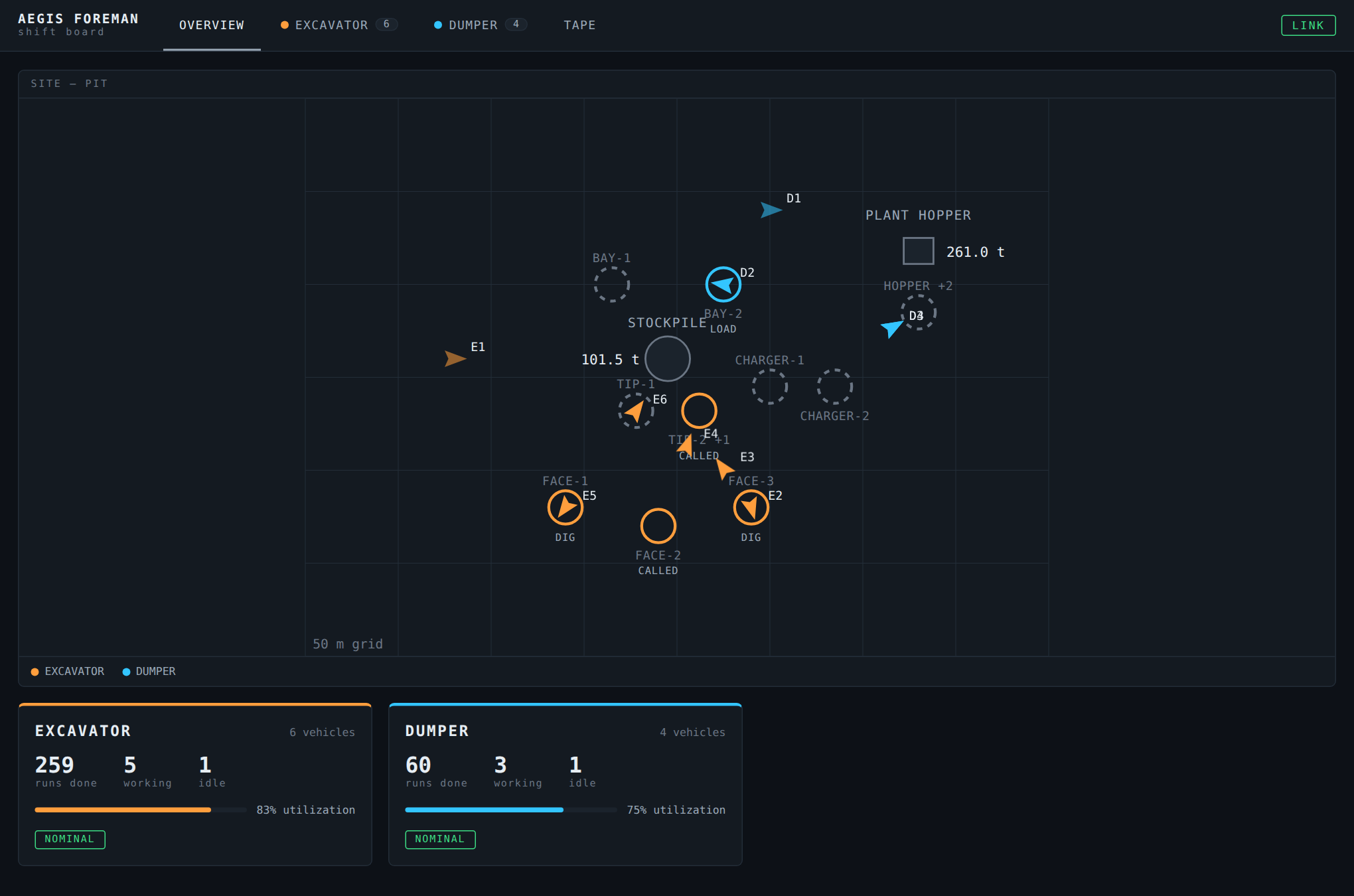
The Foreman shift board's overview: a map of a pit on a 50 metre grid with three dig faces along the bottom, two tipping lanes under a stockpile in the middle, two loading bays above it, a plant hopper at the upper right and two chargers between; orange excavators and blue dumpers drawn as arrowheads where each is, pointing where it is heading; under the map a card for each fleet with its runs done, how many are working and its utilization
FIG. 01 — The site, with every fleet that works it. Each vehicle is drawn where it is and pointing where it is going. A ring is a station: solid while a vehicle holds it, with the work being done named under it and a count of those waiting their turn. The stockpile and the hopper show their tonnes. FM-BOARD-001
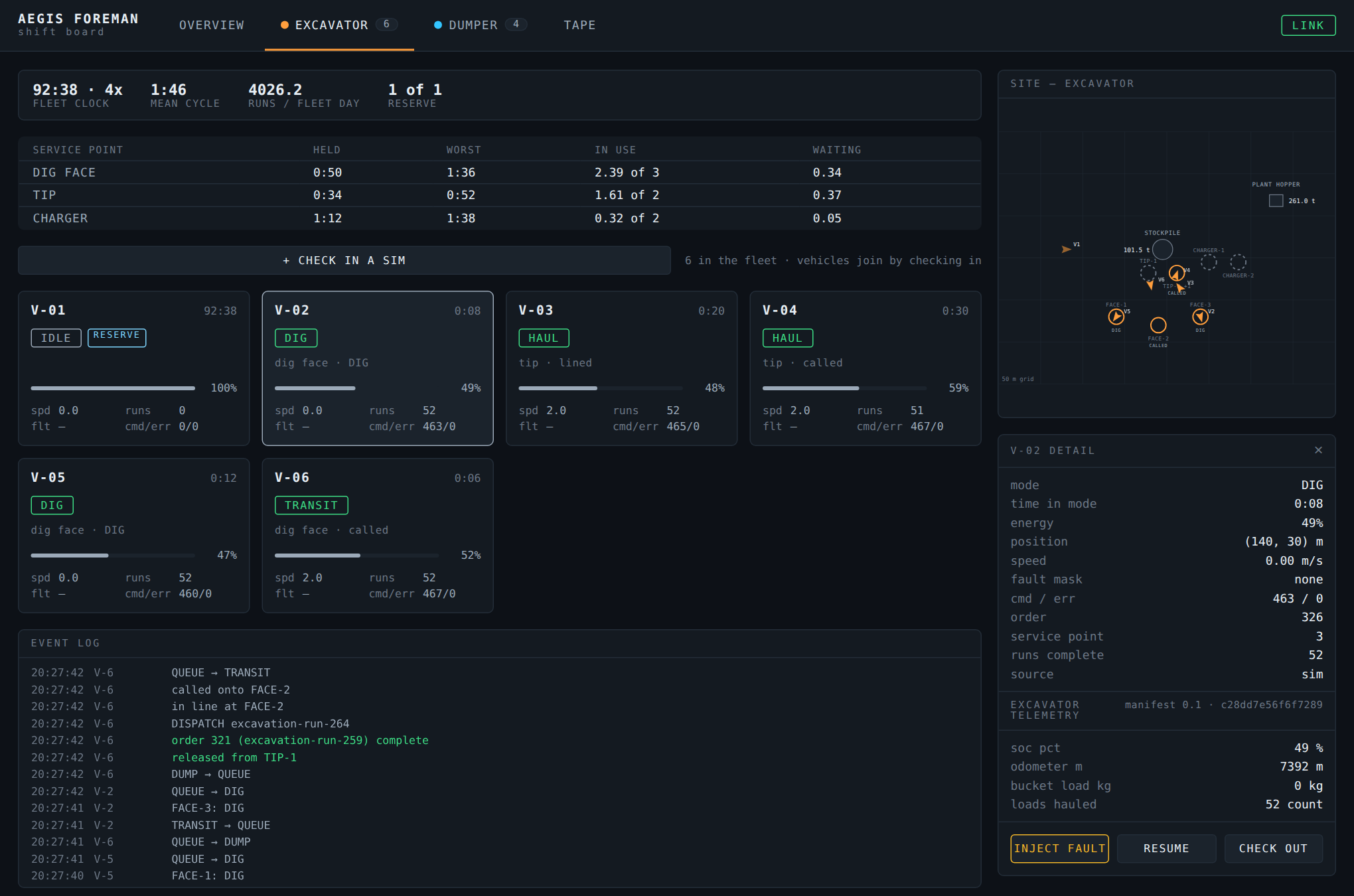
The excavator fleet's tab: the fleet clock at four times real time, a table of dig face, tip and charger with how long each is held, how many are in use and how many vehicles wait; six vehicle cards, one idle and marked reserve, the others digging, tipping or driving, each with where it is on its route; an event log; and at the right the site map and one vehicle's detail
FIG. 02 — One fleet, one tab. The table is the answer a site planner wants: for each kind of station, how long a vehicle holds one, how many are in use, how many vehicles are waiting. One excavator is held in reserve to take over if another stops. FM-BOARD-002
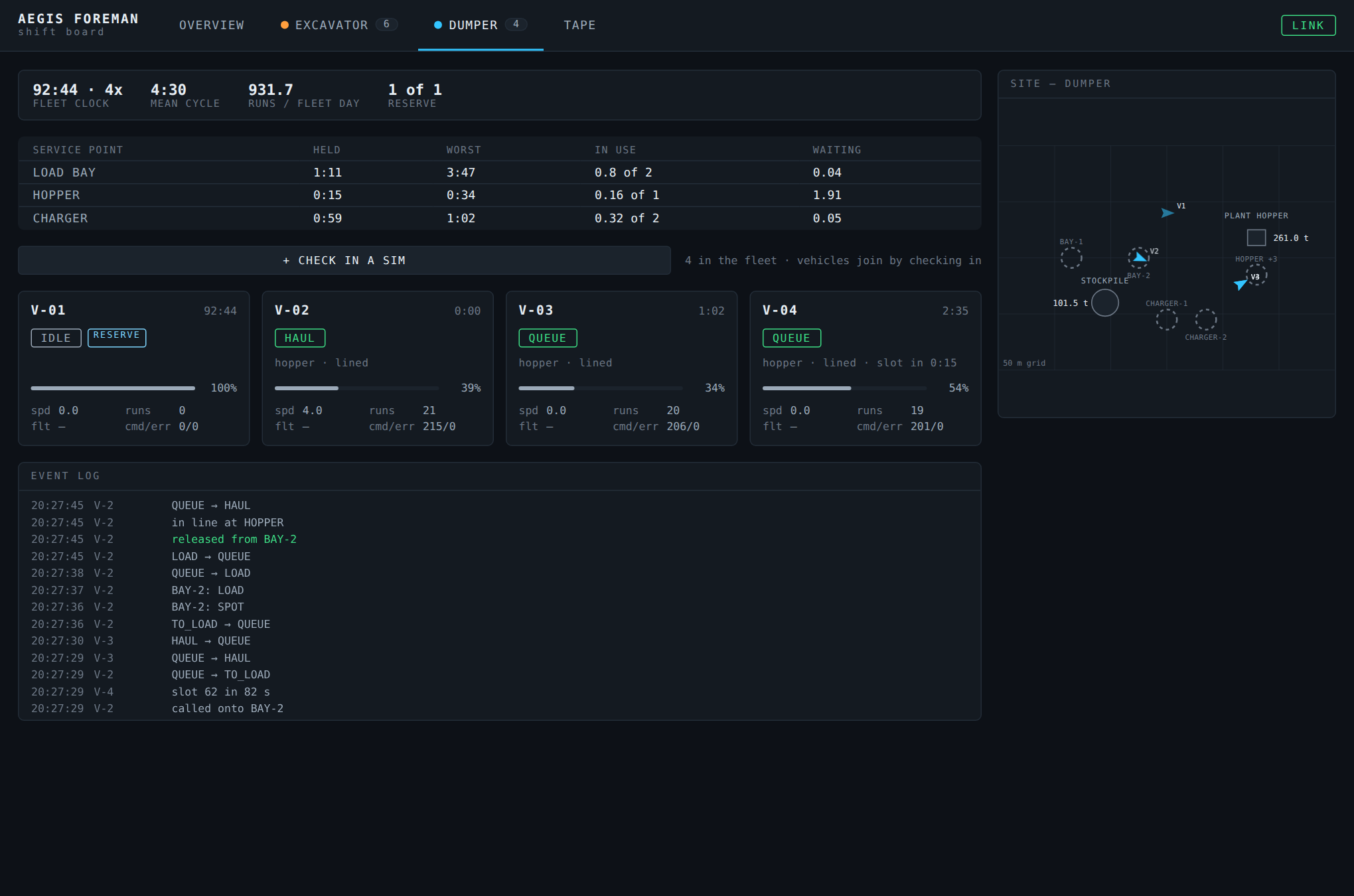
The dumper fleet's tab: loading bays held a little over a minute with almost no wait, the hopper held fifteen seconds with nearly two dumpers waiting for it on average; three dumpers working, two of them in the hopper's line and one called onto it with seven seconds to its slot
FIG. 03 — The dumpers, and the pit's bottleneck in one row: the hopper is in use a sixth of the time and has two dumpers waiting for it, because the plant takes one load every 90 seconds. The dumper called onto it has seven seconds to its slot. FM-BOARD-003
// 03 What, Where, and Who Goes Next

Three things have to be said to run a fleet, and they belong to three different owners. Keeping them apart is what lets a new machine, or a rearranged site, be a change to one file and not to the software.

The Vehicle Says What

Duty statesIDLE / WORKING / DONE / FAULT
Its routeSTATION KINDS, IN ORDER
Its workVERB, AND WHAT SHOWS IT DONE
What it reportsFIELDS WITH UNITS
FormONE DUTY MANIFEST

The Site Says Where

StationsKIND, NAME, PLACE
Site equipmentITS OWN TIMED STEPS
CadenceONE RELEASE EVERY N s
SharingANY FLEET THAT NEEDS IT
FormONE SITE PLAN

The Foreman Decides Who

OrdersONE PER IDLE VEHICLE
LinesFIRST COME, FIRST SERVED
StationsONE VEHICLE AT A TIME
CompletionON TELEMETRY, NOT A TIMER
Fleet telemetry2 Hz
A Fleet Is Whoever Has Checked In
The Foreman does not start its vehicles. A vehicle arrives at a running shift with its duty manifest and says how it can be reached. If a fleet with that duty exists, it joins it. If none does and the site has every kind of station the duty needs, it founds one. If the site cannot host it, it is refused and told which stations are missing. A vehicle that leaves finishes the job it has first.
// 04 What It Coordinates
01 — SATURATE

Keep Every Vehicle Working

An idle vehicle is given the next job at once. The fleet is limited by its stations and its vehicles, never by someone noticing that one is free.

02 — DECONFLICT

One Vehicle on a Station

Every station has a line. A vehicle waits its turn a few metres off, is called on when the station is free, and holds it only while it is being worked on. Two loading bays serve four dumpers because a bay is free again the moment its dumper pulls away.

03 — SHARE

Stations Between Fleets

A charger does not belong to the excavators or the dumpers. Both fleets wait in the one line and are served in the order they arrived, with nothing above the two Foremen to arbitrate.

04 — SCHEDULE

Meet a Downstream Rate

When a plant takes one load every so many seconds, the hopper keeps slots. A dumper is called onto it just in time for its slot, so the hopper is held for the tip and the waiting happens in the line.

05 — RESPOND

Heal Around a Stopped Vehicle

When a vehicle faults, its job goes back to the front of the queue, its station is freed, and a vehicle held in reserve takes the job. A vehicle that sits too long in one state is flagged; one that is waiting for a reason the site explains is not.

06 — MEASURE

Tell the Planner What Is Short

For each kind of station: how long one is held, how many are in use, how many vehicles wait. Whether the site needs a fourth dig face, a second hopper or another dumper is read off the board.

// 05 A Pit, as Run in Simulation

The Foreman exists and runs, as of November 2026. What it has run is of two kinds, and they should not be confused.

Real flight software. The WOK water prospector is the one surface vehicle with flight software today, and the Foreman runs it. Two copies of that software were started by a separate launcher, checked in to an empty shift with the prospector's duty manifest, formed a fleet on a survey grid, and were dispatched and tracked on their own telemetry. Nothing in the Foreman is written for the WOK: its states, its commands and the layout of its telemetry are all read from its manifest.

Generic vehicles, simulated. The excavators and dumpers on this page are nobody's design. They are generic stand-ins for the earthmovers a site would bring, each described to the Foreman by the same one-file duty statement a real machine would supply: they drive across a map at a fixed speed, take the same commands and report the same states. The run pictured is six excavators and four dumpers, one of each held in reserve, with the plant taking a load every 90 seconds. In 93 minutes of site time the excavators made 262 runs from three dig faces and the dumpers 61 hauls, delivering 265 tonnes to the hopper with 106 tonnes left on the stockpile. No vehicle faulted, none was flagged as stuck, and no station step overran.

The useful result is the shape, not the tonnage. The excavators dig faster than the plant will take it, so the pile grows; the dumpers spend their waiting at the hopper, not at the loading bays; and the board says so in one row. Change the plant's rate or add a dig face in the site plan and the same fleets rearrange themselves around it.

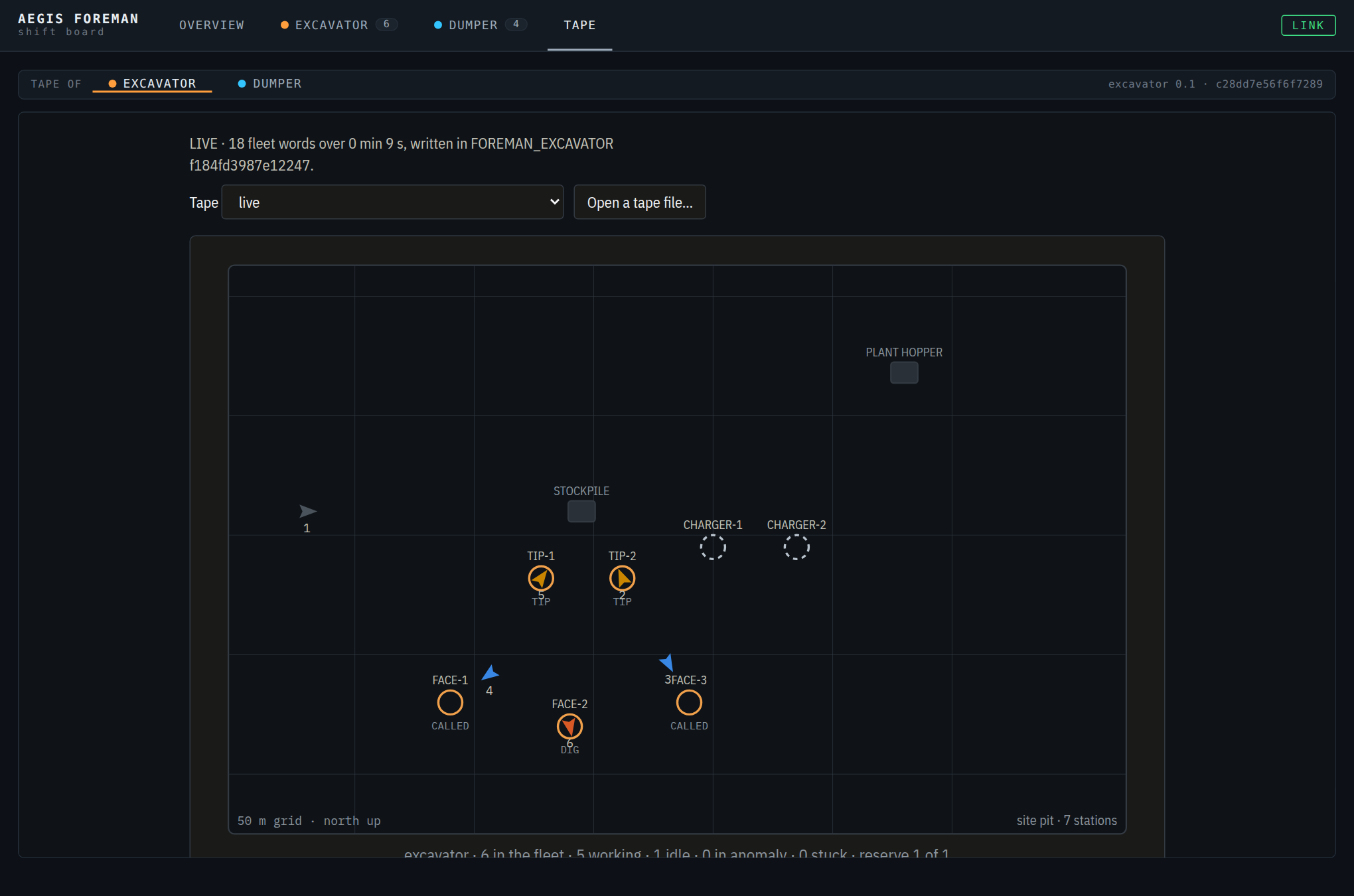
The shift board's Tape tab: the excavator fleet drawn from its recorded words as a map of the pit with stations and vehicles, a line of fleet figures, and a card for each vehicle with its state and where it is on its route
The same fleet as a record. Every tick the Foreman's view of its fleet is written down in a fixed vocabulary generated from the vehicle's manifest and the site's stations, with its decisions and any faults beside it, so a shift can be replayed and studied afterwards. FM-SIM-001

What it does not do is stated as plainly. The pit's distances, speeds, loads and times are the simulation's own and come from no vehicle design. The stand-ins drive in straight lines and nothing keeps two of them apart on the way; only the stations are deconflicted. The site's own equipment, such as a loader at a bay, is a timed step and not a machine. Vehicles check in through a launcher that speaks for them, on the same computer, over a link with no authentication; a vehicle that announces itself over a real radio link is not built. And the tanker fleet still runs under its own Fleet Commander: expressing a tanker's sortie, with its launch windows and booked berths, as a Foreman duty is designed for and not yet done.

← Back to Aegis Station