Aegis Station Logistics Program

Fleet CommanderGround Control for the Lunar Tanker Fleet

The ground-side coordinator that dispatches sorties, deconflicts pads, holds emergency reserves, and maximises water throughput to station — one console commanding the entire 45-tanker constellation.

45
Tankers / 1 Console
6 + 6
Pads / Berths
1 Hz
Fleet Telemetry
// 01 Ground Segment Overview
Safety Boundary
Mission-Critical
Not safety-critical. If the coordinator goes down, every vehicle holds its current mode safely under its own autonomous flight software.

Each tanker flies its own safety-critical flight software — autonomous flight, fault detection, and safing all live on the vehicle. The Fleet Commander is the ground-side brain: it never flies a ship, it orchestrates the fleet.

It talks to all 45 vehicles over the same CCSDS-over-UDP link an individual operator console uses — every tanker is an independent command and telemetry endpoint. The coordinator aggregates per-vehicle telemetry into fleet-wide situational awareness at 1 Hz and issues a small, well-defined command vocabulary back to each ship.

// 02 Ground Control Console

Frames below are screen captures of the coordinator in operation — a live tanker fleet under auto-dispatch, with telemetry refreshing at 1 Hz.
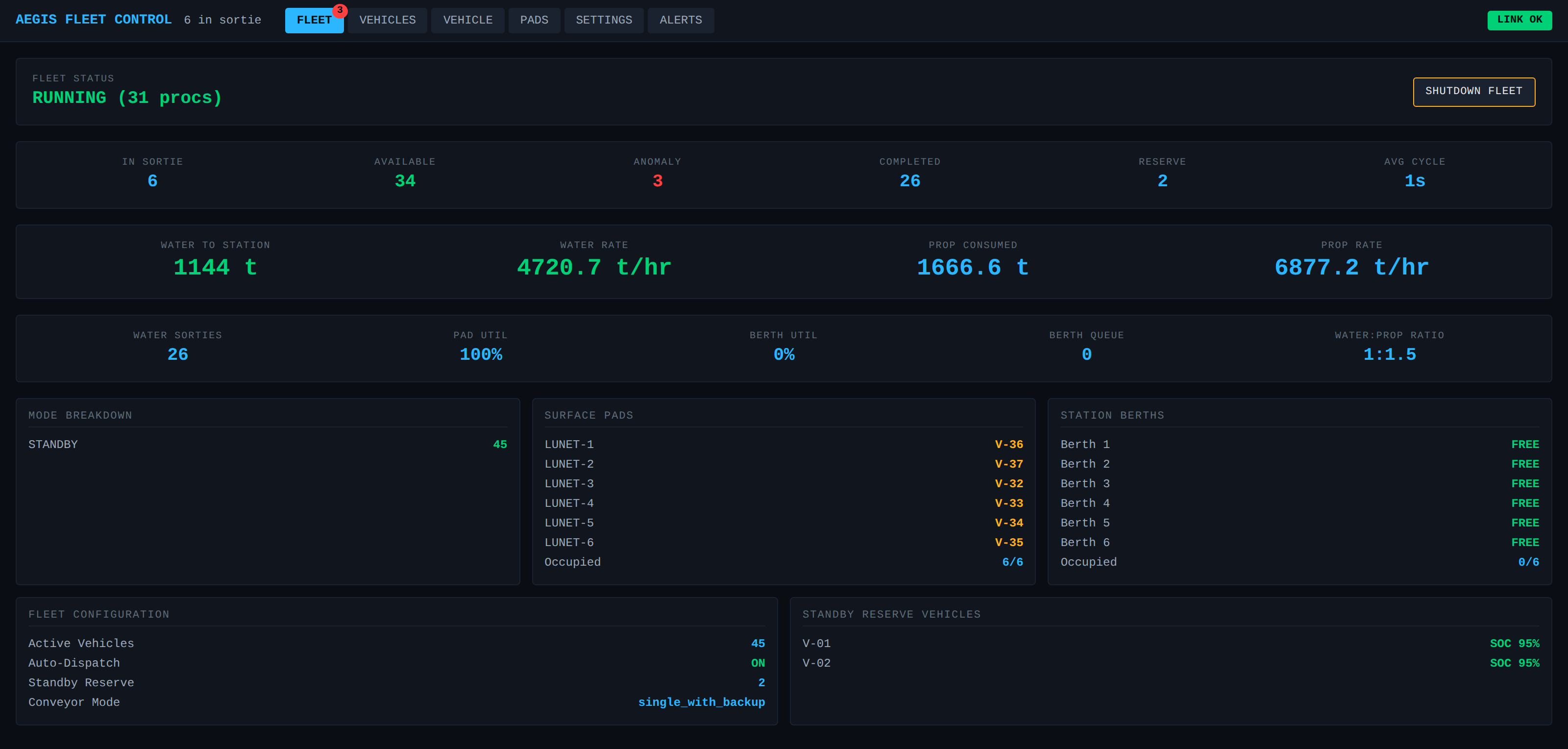
Fleet Commander — fleet overview
FIG. 01 — Fleet Overview: water throughput, mode breakdown, pad & berth occupancy FC-CONSOLE-001
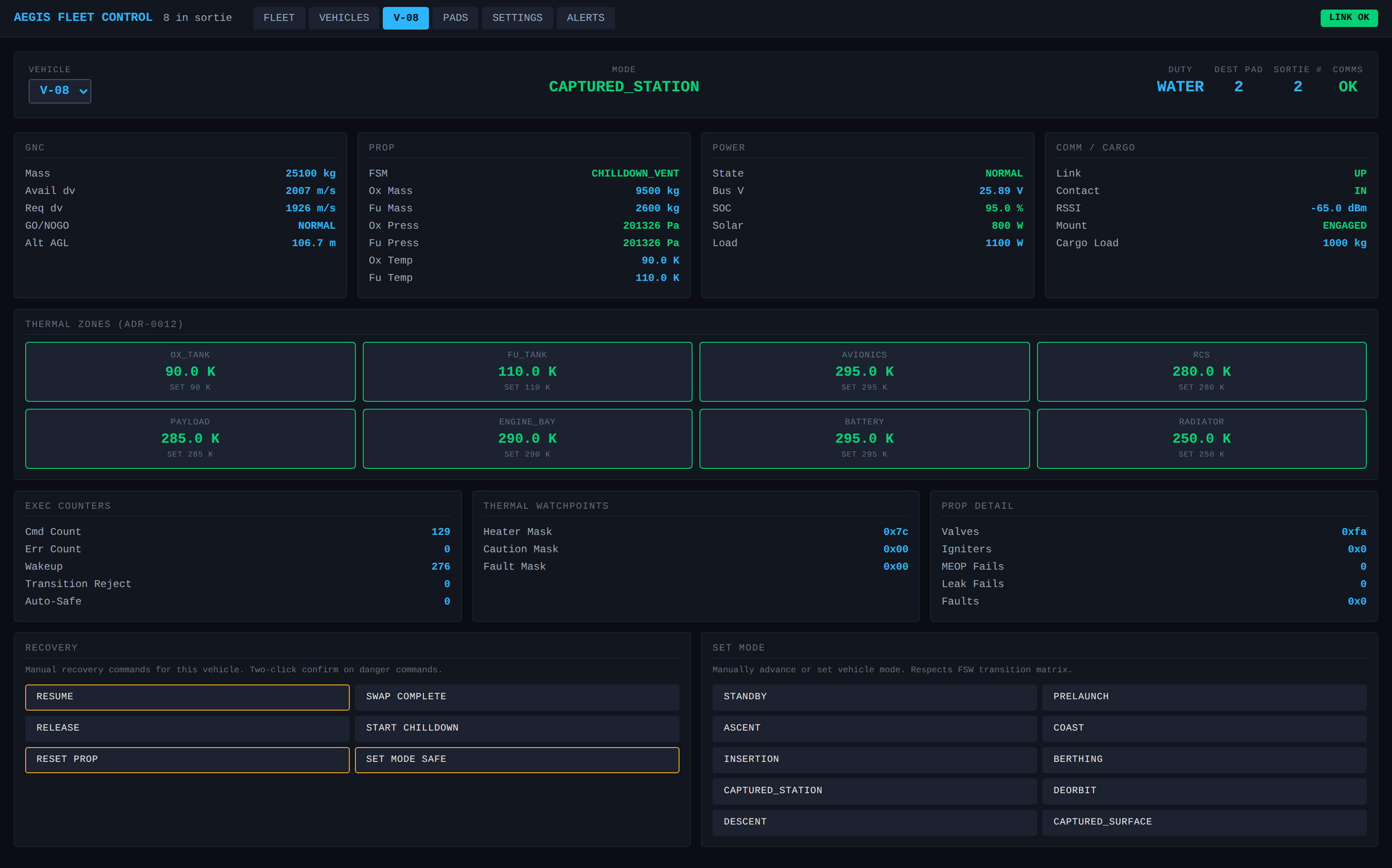
Fleet Commander — single-vehicle telemetry
FIG. 02 — Vehicle Detail: GNC, propulsion, power, thermal zones & recovery commands FC-CONSOLE-002
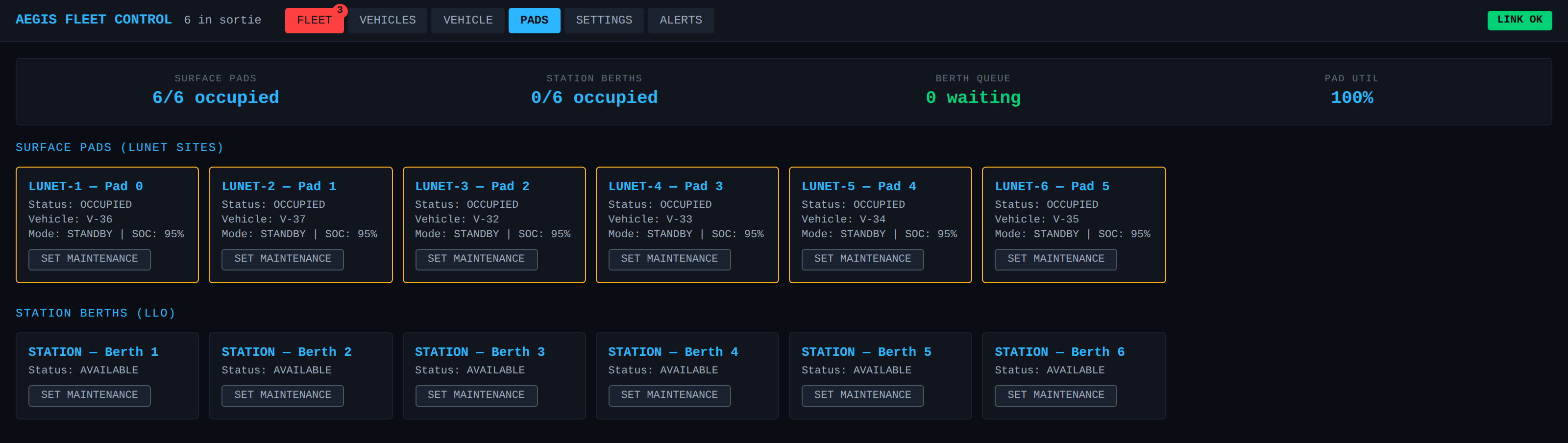
Fleet Commander — pad and berth deconfliction
FIG. 03 — Pad & Berth Status: 6 LUNET surface pads, 6 station berths, FIFO berthing queue FC-CONSOLE-003
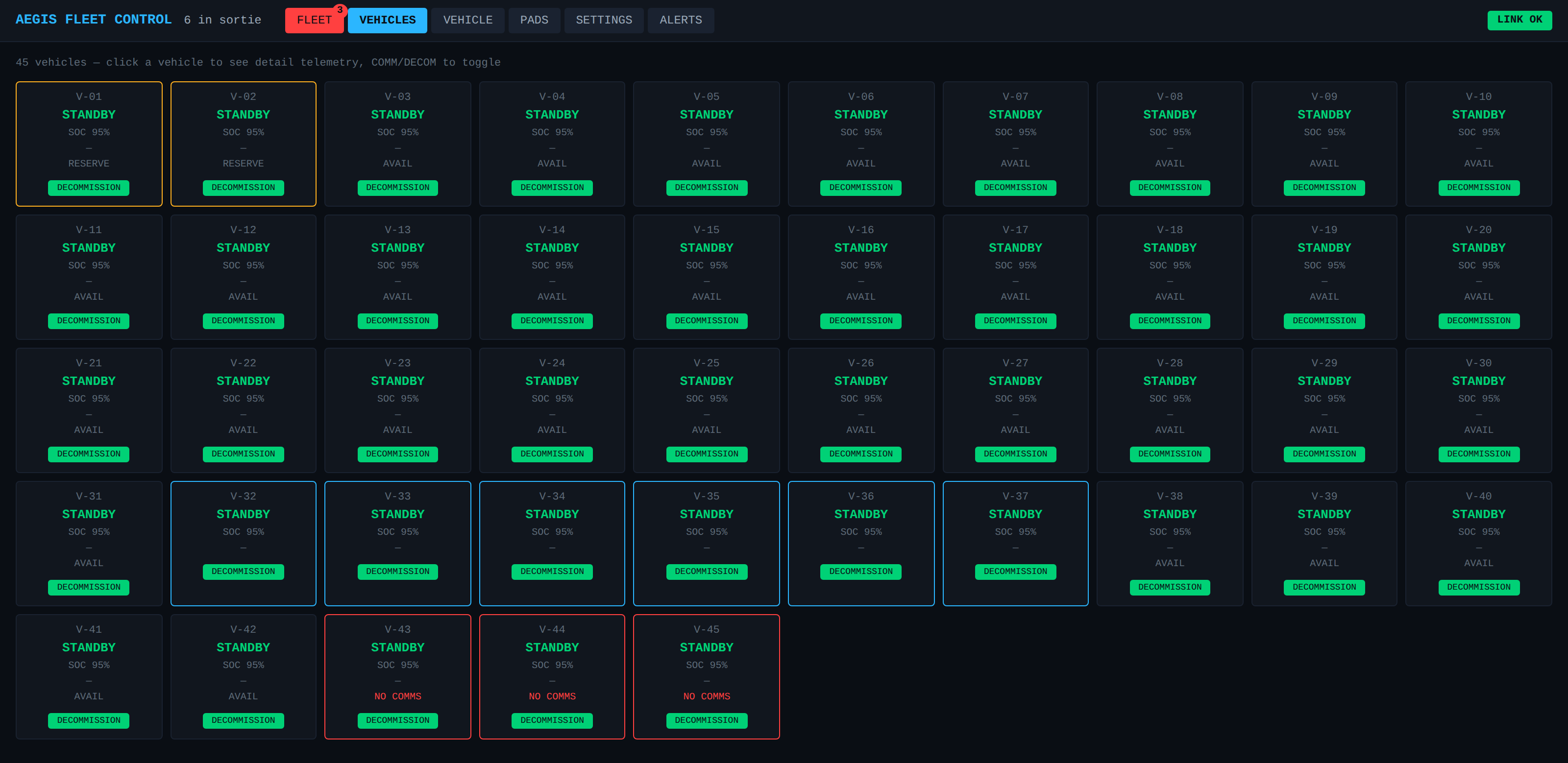
Fleet Commander — vehicle grid
FIG. 04 — Vehicle Grid: per-ship mode, charge, reserve and comms health — offline ships flagged in red FC-CONSOLE-004
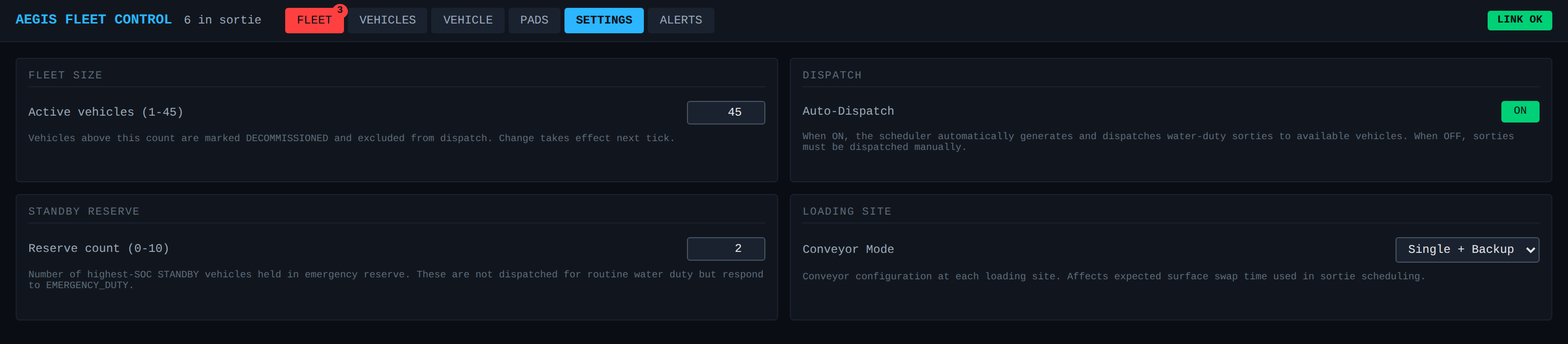
Fleet Commander — coordinator settings
FIG. 05 — Coordinator Settings: fleet size, auto-dispatch, standby reserve, loading-site mode FC-CONSOLE-005
// 03 Fleet–to–Vehicle Contract

Command Vocabulary — ADR-0014

DISPATCHASSIGN SORTIE
RELEASEFREE PAD / BERTH
SWAP_COMPLETECARTRIDGE SWAPPED
RESUMEEXIT SAFE / STANDBY
SET_MODEFSM ADVANCE
TLM SUBSCRIBESTATE TRACKING

Transport & Telemetry

LinkCCSDS / UDP
Endpoints1 PER VEHICLE
Fleet TLM Rate1 Hz
State ModelTLM-GATED
Console LinkWEBSOCKET
DeploymentGROUND SEGMENT
Clean Separation — FSW ADR-0006 / 0014
The interface is the only coupling between ground and flight. Vehicle FSW is one image flown in 45 copies on each ship's flight processor; the coordinator is a single ground instance managing all 45. Different deployment target, different scaling model, different safety boundary — joined by one deterministic command/telemetry contract.
// 04 What It Coordinates
01 — DISPATCH

Sortie Scheduling

Selects which vehicle flies the next sortie from state-of-charge, thermal state, maintenance status and position — maximising water delivered per unit time.

02 — DECONFLICT

Pad & Berth Management

Guarantees one vehicle per pad across six LUNET surface sites and six station berths, with a FIFO berthing queue when station capacity is saturated.

03 — RESERVE

Standby Allocation

Holds one to two highest-charge vehicles in emergency reserve per the fleet spec — excluded from routine water duty, ready for emergency tasking.

04 — REROUTE

Surface-to-Surface Routing

Plans suborbital hops between LUNET nodes to reposition the fleet where the next demand is, without a return to station between legs.

05 — RESPOND

Anomaly Response

When a vehicle goes SAFE or ABORT, its pending sortie is reassigned and its pad freed — the fleet heals around the loss without operator intervention.

06 — OPTIMISE

Throughput & Awareness

Aggregates 45 telemetry streams into fleet-wide situational awareness and drives the conveyor of sorties that keeps water flowing to station.