// 01
Fleet Render
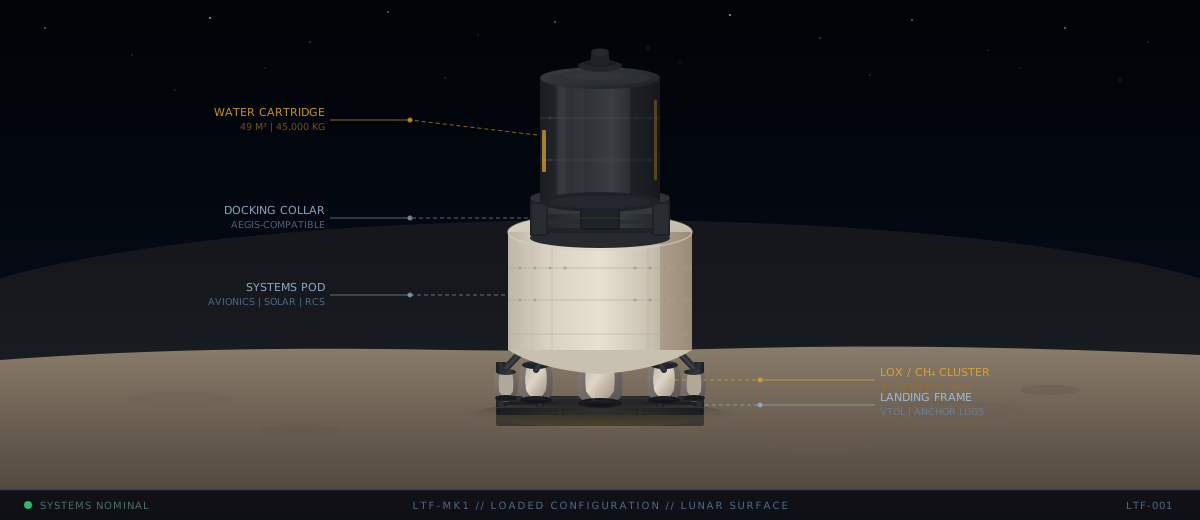
FIG. 01 — LTF-MK1 Loaded Configuration, Lunar Surface — Water Cartridge Mounted
LTF-RENDER-001
45 autonomous tankers. 3.3 million metric tons. A continuous cycle of ascent, delivery, and return — building humanity's first orbital city one payload at a time.
The fleet's first operational mission is lifting the first ISRU cartridges to the Lunar Orbital Propellant Depot. Single vehicle, low cadence — enough to commission end-to-end propellant production before the shield-fill campaign begins. Depot first light does not require full fleet deployment.
Sustained surface-to-LLO water delivery to Aegis Station shield reservoirs. Fully autonomous operations across continuous 2,600 m/s ascent-and-return cycles. This is the requirement that sizes the full ~45-vehicle fleet — not depot operations.
From first light onward, depot resupply runs in parallel with the shield-fill campaign and continues indefinitely after it. The depot is the fleet's first customer and a permanent one — not a post-fill handoff. Post-fill, the same cycle extends to EML1/2 hubs and deep-space propellant staging.
Ballistic surface hops between ISRU nodes for LOX and water redistribution. 160–940 m/s per hop — up to 6× sorties per orbital propellant load. Becomes operationally relevant once multiple ISRU nodes are producing at capacity.
1–2 tankers maintained in standby at all times. Emergency water delivery to crewed outposts achievable within 6–8 hours of dispatch authorization.
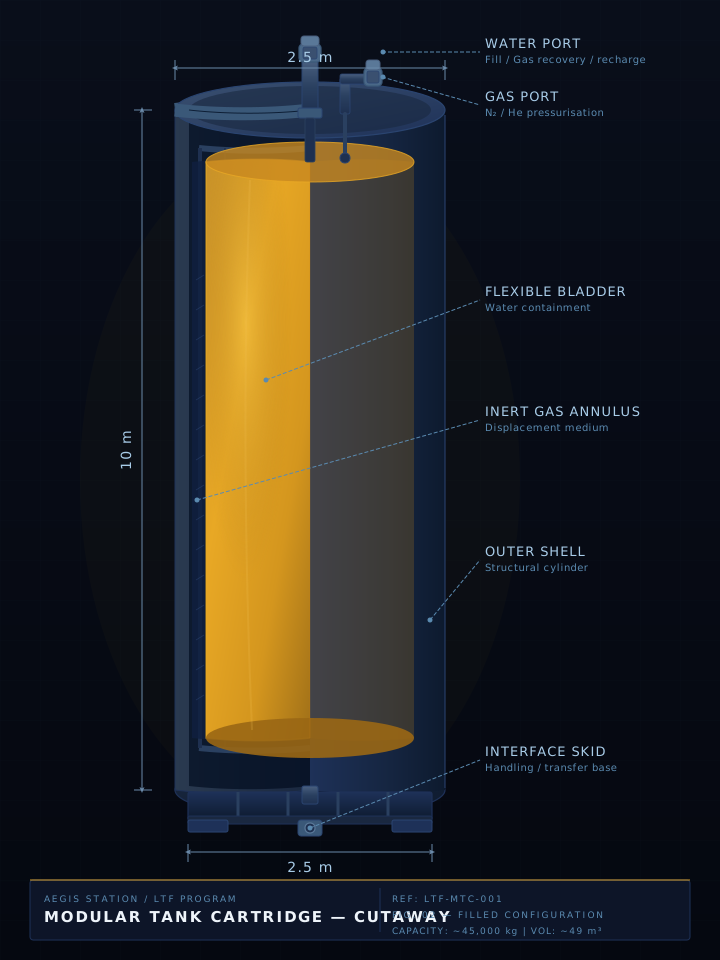
The Modular Tank Cartridge (MTC) is the fundamental unit of the LTF logistics chain — a standardized, self-contained water vessel designed for drop-in handling at every point from the ISRU node to the Aegis Station shield reservoir. The cartridge is not a component of the tanker; it is cargo that the tanker carries. This distinction is the key to the system's operational simplicity.
Per-vehicle flight software implementing the full mode FSM, propulsion feed control, autonomous safing, and CCSDS command/telemetry. Multi-vehicle simulation exercising 45 concurrent instances through complete sortie cycles — ascent, orbital insertion, station capture, cargo swap, deorbit, and surface return.
Fleet-level dispatch scheduling, pad deconfliction, station berth queuing, and telemetry-gated ground operations across the full vehicle complement. The sortie cycle runs autonomously with real-time cargo and propellant state verification at every transition — no operator in the loop for nominal operations.
The LTF tanker requires no structural redesign for surface-to-surface operations. Its VTOL architecture and LOX/LH₂ propulsion are inherently suited to ballistic hops between ISRU nodes — ascending on a near-vertical vector, coasting at low altitude, and performing a precision landing at the destination pad.
This capability transforms a collection of isolated extraction points into an integrated logistics network, allowing surplus LOX and water to flow to nodes in deficit rather than being vented or stockpiled past capacity.
High-yield nodes producing excess liquid oxygen redistribute to nodes in deficit. Delivered LOX feeds directly into tanker refueling operations at the destination, creating a shared propellant pool across the network.
ISRU extraction failure at a crewed outpost triggers autonomous dispatch from the nearest surplus node. First delivery achievable within 6–8 hours — no crew or operator action required at the origin site.
New exploration outposts 900+ km from the nearest ISRU hub receive propellant caches via a series of surface hops, establishing operational independence before local production comes online.
3–5 tankers operate in dedicated S2S rotation, executing scheduled monthly rebalancing of LOX and water inventories across all active nodes under autonomous dispatch control from Aegis Station.
The Moon has water ice. Electrolysis splits it into liquid oxygen and liquid hydrogen — the two highest-performing chemical propellants there are, and the only ones the Moon can make from a single feedstock without importing anything. The tanker burns both from its first flight. There is no methane phase, no transition, and no import to taper off later.
An earlier revision of this page baselined methalox for the shield-fill campaign with methane shipped from Earth, and treated hydrolox as a later upgrade. That was backwards. At fleet cadence the methane alone would have been a recurring import measured in hundreds of tonnes a day, landed on the Moon — a supply chain larger than every lunar landing to date, repeated indefinitely. Anything a program has to keep buying from Earth is the thing that ends it. So the fuel that needs an Earth supply chain is gone, and the vehicle is designed around the one that doesn't.
The hydrogen objection is real and this architecture answers it the same way LUNET does: produce near, consume fast. A tanker fills from a liquefier a few metres from the pad and is empty in orbit within hours. That is the shortest hydrogen dwell any lunar vehicle will ever have. The long-dwell problem — boil-off, thermal-cycle fatigue on transfer lines, embrittlement — belongs to depots holding LH₂ for months, not to a vehicle that burns its load the same day it is filled. Zero boil-off storage at 20 K has already been demonstrated at twice the previous state of the art, and the industry's own next-generation lunar lander is hydrolox for precisely this reason: it is the propellant ISRU can actually make.
The honest cost moves from the launch manifest to the power plant. Hydrogen is a ninth of water by mass, so a full tanker load means splitting several times its own hydrogen mass in water and liquefying the result. The tanker pad is therefore not a LUNET fill node — it is a refinery-class facility, with power to match, and it is the same plant the depot and the surface network already assume exists. One thing to build, once, on the Moon; not something to keep launching.
A single vehicle at low cadence lifts the first cartridges to the depot, fuelled from the first pad-side electrolysis and liquefaction string. Sortie rate is set by how fast the pad can make hydrogen, not by the vehicle. This is the end-to-end proof: water out of the ground, propellant on the pad, cartridge in orbit, nothing from Earth.
Pad-side production scales to fleet cadence: additional electrolysis strings, liquefiers and fission modules are added in parallel with vehicles, and the refinery grows with the fleet rather than ahead of it. Every sortie flies on the same propellant as the first one. Nothing in the vehicle, the pad, or the fleet software changes between first light and full cadence.
The depot's electrolysis hydrogen — once a vented byproduct — is stored as propellant in orbit for visiting vehicles and for contingency top-off of the fleet; routine tanker refuelling stays at the surface pad, so the loop closes at both ends of the ascent without the depot in the daily cycle. The same fleet serves depot resupply, surface distribution and emergency response indefinitely, still without an Earth-supplied consumable.
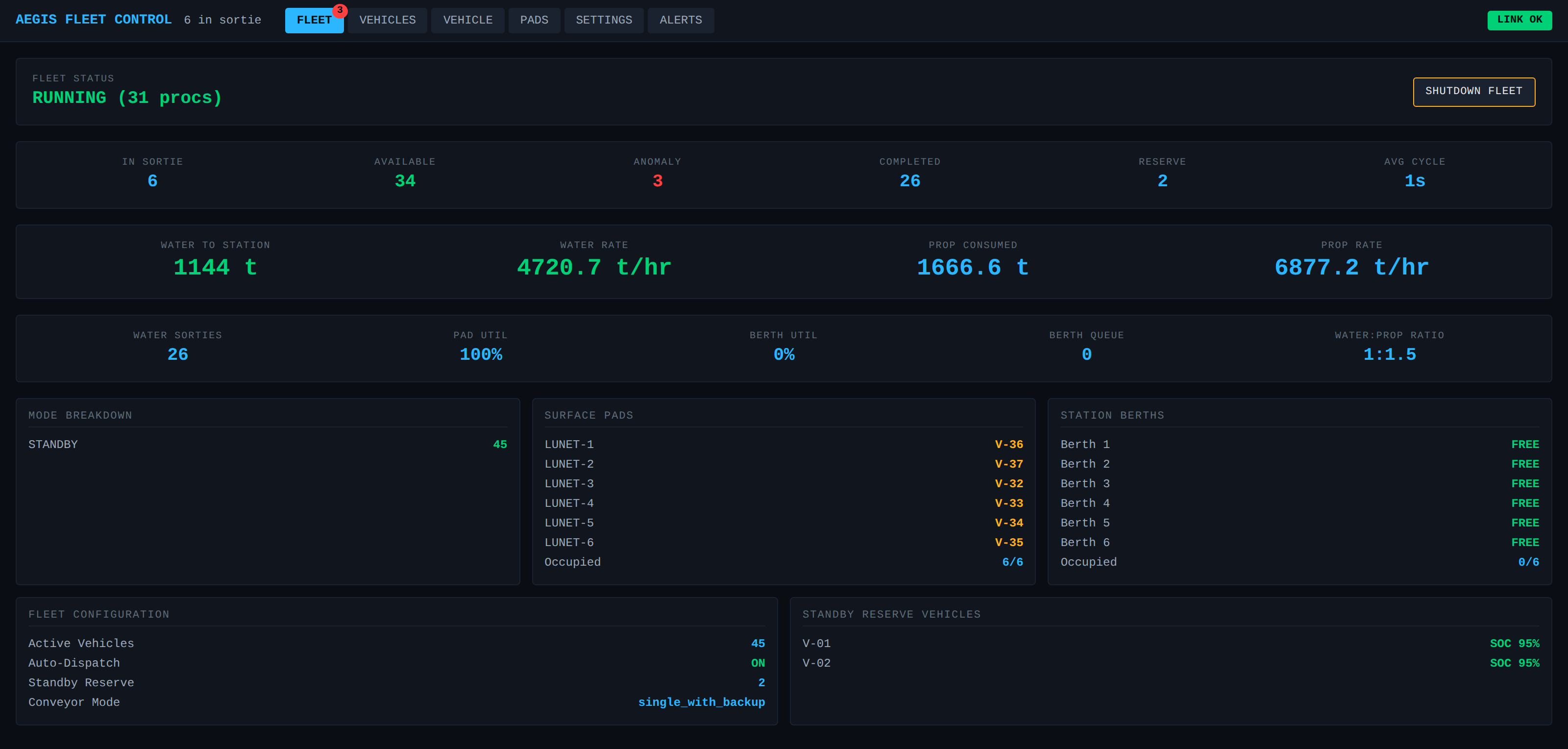
The tankers fly themselves. Coordinating them — deciding who flies the next sortie, keeping one ship to a pad, healing the schedule around an anomaly, and squeezing maximum water to station — is the job of the ground-side Fleet Commander.
Open the Fleet Commander →