Home / Aegis-Class Rover / Aegis-Class Lunar Surface Mobility Platform
Architecture Reference February 2026
Aegis-Class Rover

Aegis-Class Lunar Surface Mobility Platform

A pressurized, long-duration lunar rover architecture designed for 30–60 day missions, polar operations, and integrated logistics—combining habitation, mobility, dust control, and a roof-integrated power/thermal stack sized for real field work.

Pressurized 30–60 day missions Crew: 2–4 South Pole capable Suitport + dust boundary SSSRA roof stack

System Overview

  • Primary role: pressurized surface mobility and habitation for extended lunar field operations.
  • Secondary roles: prospecting support, logistics transport, mobile command, emergency shelter, and storm refuge.
  • Design objective: sustain productive crew operations without treating the cabin as a cockpit-with-bunks.
  • Integration: sized for polar illumination geometry and dust reality; built to operate as infrastructure, not a stunt vehicle.

Constraint-driven architecture

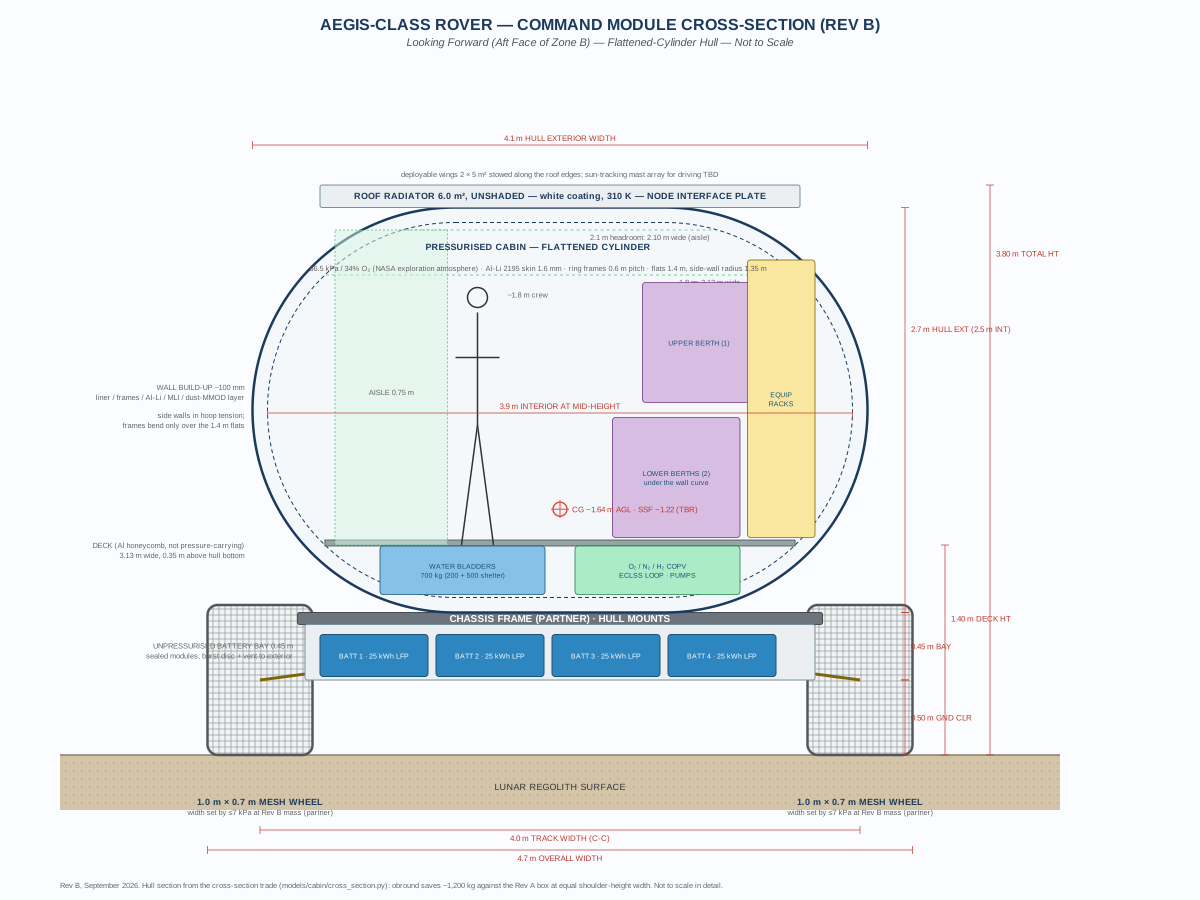
Interior standing height drives hull size, which drives CG height, which drives track width and stability, which then defines the roof footprint available for power generation and thermal rejection.

Baseline Key Specs

Gross vehicle mass

~5,400 kg (laden)

Crew / mission duration

2–4 crew • 30–60 days

Overall dimensions

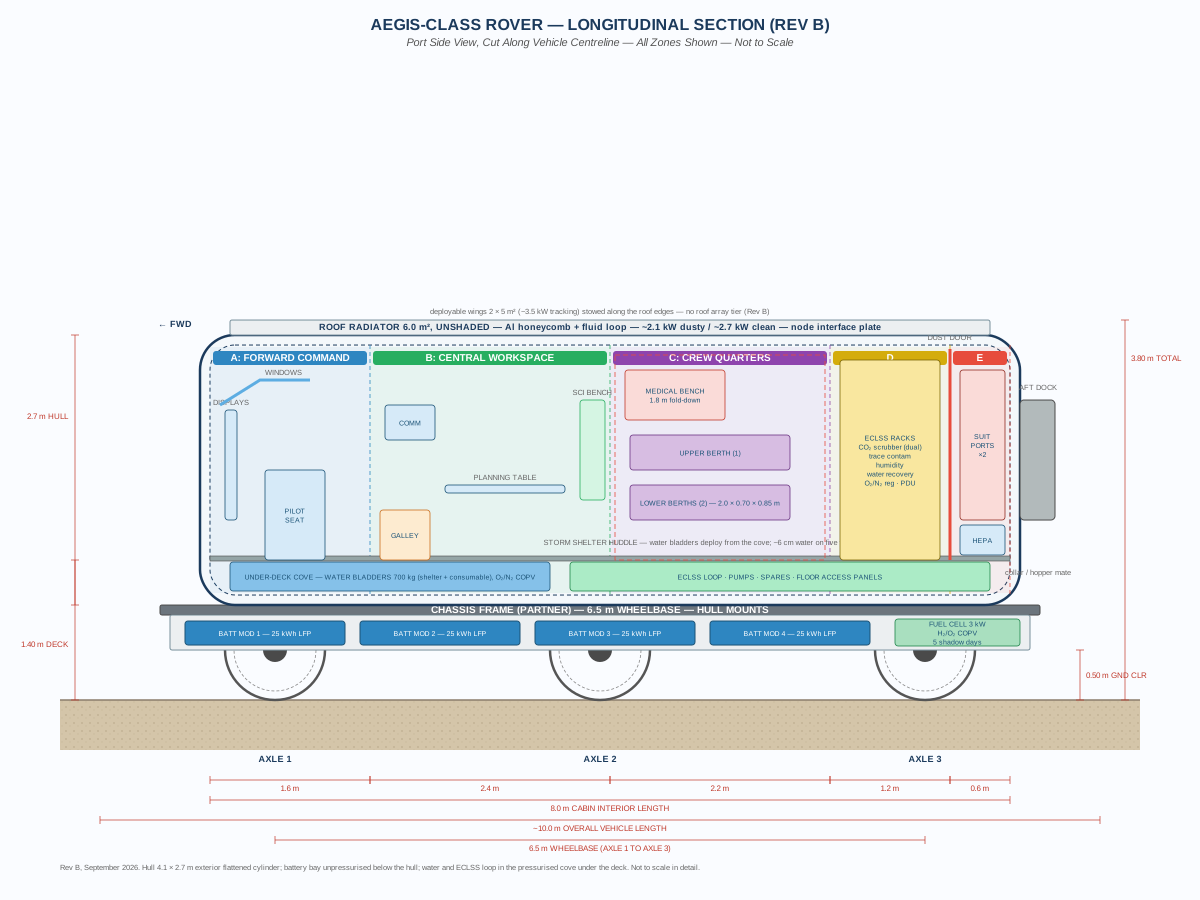
~10 m L • 4.6–4.8 m W • 3.9 m to array top

Stability

Track 4.0 m • CG ~1.54 m • SSF ~1.30

Habitable volume

~57 m³ gross • ~38–42 m³ net

Mobility performance

Cruise 10–15 km/h • Sprint 25 km/h

Mobility & Terrain Handling

  • Mobility architecture: wide-track chassis with multi-axle stability geometry.
  • Terrain envelope: compacted regolith plains, loose regolith, boulder fields, crater-rim transitions, shadowed terrain.
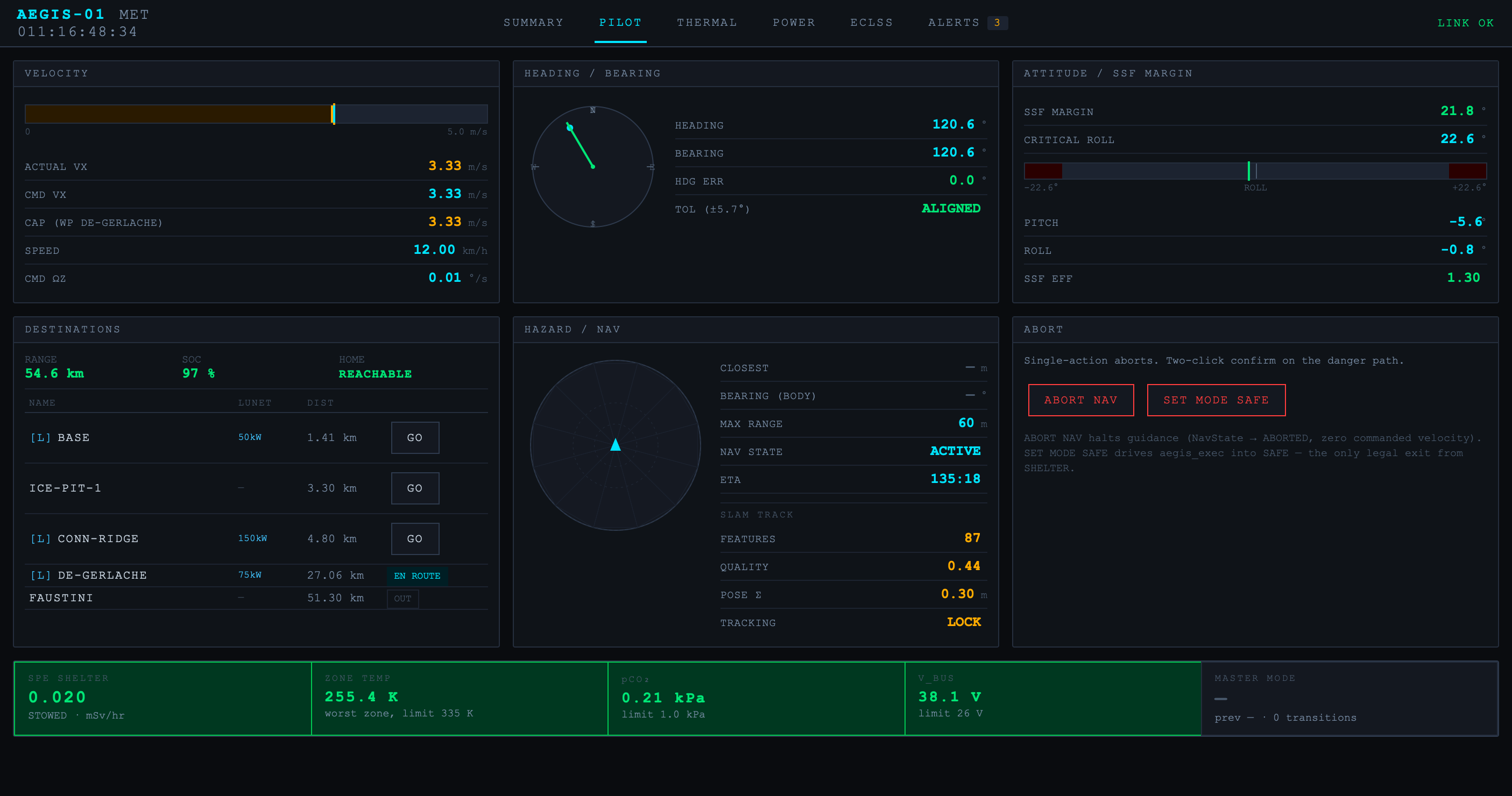
  • Driving modes: manual, remote-supervised, and autonomous traverse with hazard detection.
  • Operations emphasis: traction management and dust survivability over “heroic” torque.

Habitation & Crew Factors

  • Interior standing height: 2.1 m clear for long-duration ergonomics and psychological health.
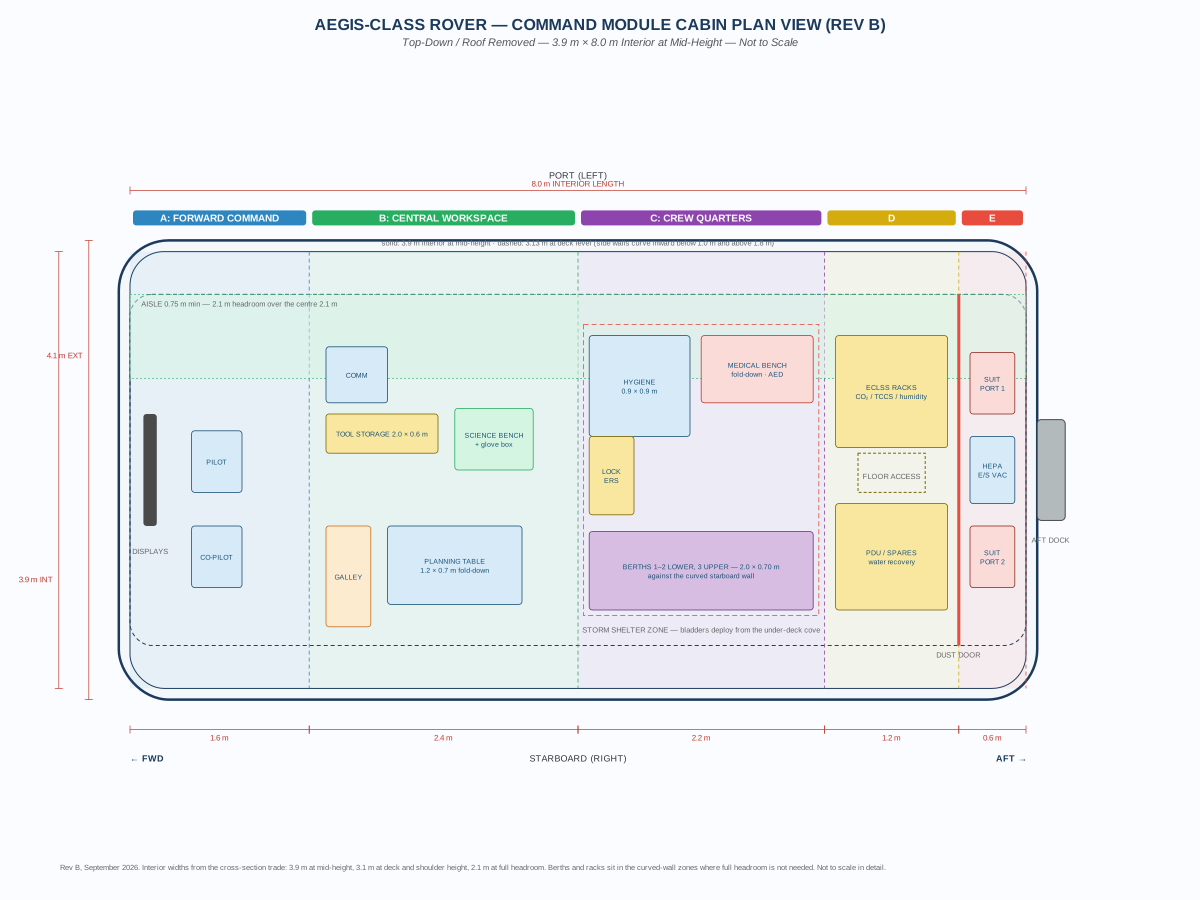
  • Functional zoning: forward command, central workspace/galley, crew quarters/medical, systems bay, vestibule.
  • Human factors: circadian lighting control, acoustic targets, privacy berths, and a “sacred” continuous aisle for emergency egress.
  • Medical capability: fold-down bench + telemedicine workflow for multi-week autonomy.

Dust Boundary & EVA Interface

  • Baseline EVA concept: suitport-driven external suit storage to keep regolith outside the pressure volume.
  • Vestibule controls: dedicated filtration, electrostatic capture, and procedural wipe-down flow.
  • Fallback mode: vestibule can operate as a traditional airlock when required for interoperability.

Power & Thermal Architecture

  • Roof integration: stacked solar-shade radiator architecture (SSSRA) for heading-independent rejection.
  • Thermal sizing: radiator area selected for nominal ~1.2 kW rejection with ~1.5 kW peak capacity margin.
  • Polar power reality: low solar elevation angles drive the need for deployable/tilted arrays and/or outpost recharge.
  • Resilience: battery storage + fuel cell option for night, shadow, and contingency operations.

Program Notes

Aegis Station Infrastructure LLC • Aegis-Class Rover
Aegis-Class Lunar Surface Mobility Platform — reference page
Last updated: February 2026