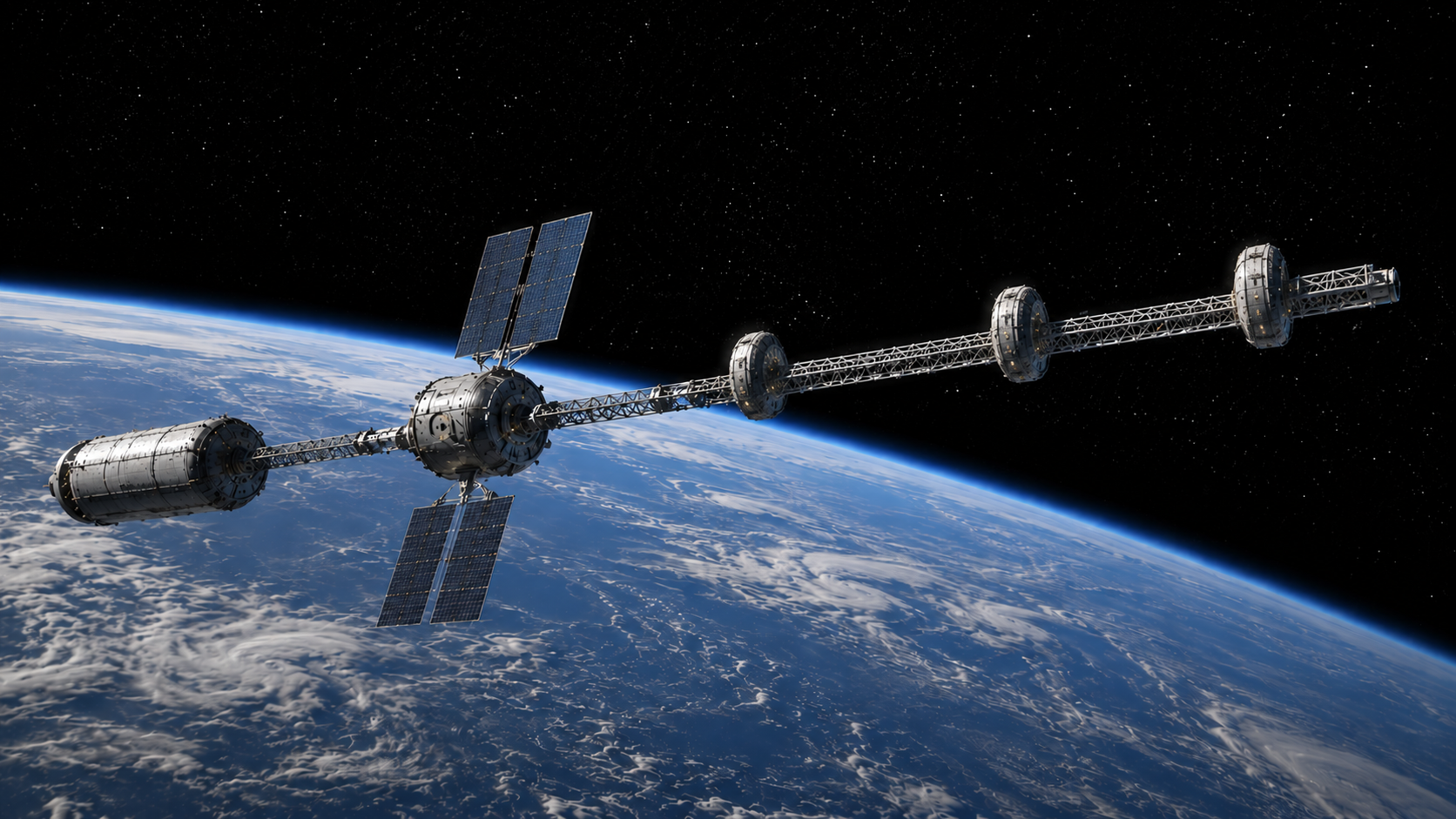
Gradient One is not a candidate in NASA’s commercial station program. A one-person design shop does not build a 230 t rotor, and the program is buying a different kind of vehicle. The two classes get confused with each other, so this note sets out how they relate. The short version is that each does something the other cannot, and they share the same infrastructure.
01What the commercial stations are for
The stations NASA will select are zero-g free-flyers in the ISS class: crews of four to eight, pressurized volume that goes up in one to a few launches, continuous occupancy. Their job is continuity. The ISS record is a quarter century of human physiology at 0g, with countermeasures that work and protocols that are standard, and it is the only long-duration dataset the field has. The program exists so that the record continues without a gap, and so that the microgravity manufacturing and pharmaceutical work now on the ISS has somewhere to go. That is the right thing to buy.
02The measurement none of them can make
Every one of those stations is a single point on the chart that matters: 0g, 0 rpm. The Artificial Gravity Requirements Evaluation on this site lays out what a Moon base or a Mars transit needs to know: what months at 0.165g or 0.38g do to bone, eyes, heart and plants, what rotation adds on top of that, and what the tolerance envelope looks like in spin rate and gravity level with confidence bounds on it. No part of that dataset exists in orbit.
A free-flyer cannot hold a gravity level. A small centrifuge aboard one can hold cell cultures and small animals at partial gravity, and that work matters, but it does not put a person at lunar gravity for six months with a floor under their feet. Gradient One is a fixed-rate rotor that holds 1g, Mars gravity, lunar gravity and a rotating 0g control in one vehicle, under one radiation environment, with one instrument suite and one diet, for 180 days at a time. It is a different class of vehicle because it is built to a different question.
03What Gradient One costs
The G1 page states these, and they belong in any comparison.
- Cost class. $5 to $10 billion to first campaign, against commercial stations being built for a fraction of that. The money buys five crew-rated modules, a bearing with people on both sides of it, and three arms a third of a kilometre long.
- No commercial customer. The customer is the research question. A free-flyer can sell volume to a dozen tenants. A rotor sells one dataset, and the buyers are agencies and the programs that follow them.
- An assembly campaign. Arm erection and module hanging before spin-up is a robotic and EVA campaign no commercial station requires. It is costed and not yet sequenced.
- Eight to ten years. The timeline is consistent with the Gateway analog and longer than any commercial station’s.
- Built by partners. Aegis is the design authority. Every physical article in the reference set is a partnership, and the build map on the G1 page says which flown hardware each element descends from and who built it.
04How the two classes fit together
Whichever stations fly, they become Gradient One’s neighbours and its infrastructure. The crew vehicles and cargo services that serve them are the ones G1 is sized to use: seven-seat capsules, standard docking at a despun node, no spin to match, 180-day docked stays. A commercial station in the same orbital class is the natural staging point for a G1 campaign and the natural place to run a crew’s pre-flight and post-flight baselines. G1 is a customer for all of that.
The benefit runs the other way too. Within a decade a station operator will face the question of whether a rotating follow-on is worth building, and at what radius and spin rate. The answer available today is a comfort chart from ground studies with Earth’s gravity superimposed. A G1 result at 1.6 rpm and 1g, with the partial-g bands beside it, turns that into an engineering decision. NASA’s own purpose statement for the commercial stations names preparation for the Moon and Mars. The free-flyers cover one half of that: long-duration operations, logistics, a place to practise. The other half is gravity, and only a rotor can carry it.
05Nothing to invent
Aegis Station rests on one premise: it is built from technology that exists now, and what remains is arrangement, verification and the supply chain. Gradient One is the same vehicle class at a smaller scale and it inherits the premise. The modules are ISS-class, the bearing is a scaled rotary joint, the arrays, docking and life support are catalogue hardware, and the build map lists the flown article behind each element and the firm that built it. Three rows on that map have no analog at the length or power G1 needs. Those are sizing and qualification work, the kind that fills an open-items list, and the G1 page lists them as such.
What is new on Gradient One is the arrangement and the measurement it makes possible. That is the whole claim, and it is the same one the station makes.