Luna–Aegis Short Hopper
The Luna–Aegis Short Hopper is a reusable single-stage VTOL lunar vehicle for crew and cargo transfer between south-polar surface sites and, in the station era, between the surface and Aegis Station in low lunar orbit. It burns ISRU-compatible LOX/LH₂ through an engine-out-capable cluster and lands powered on unprepared terrain. Its baseline mission is a 500 km surface-to-surface round trip with no refuelling at the far end; a 1,500 km one-way hop becomes available once a LUNET propellant node exists at the destination.
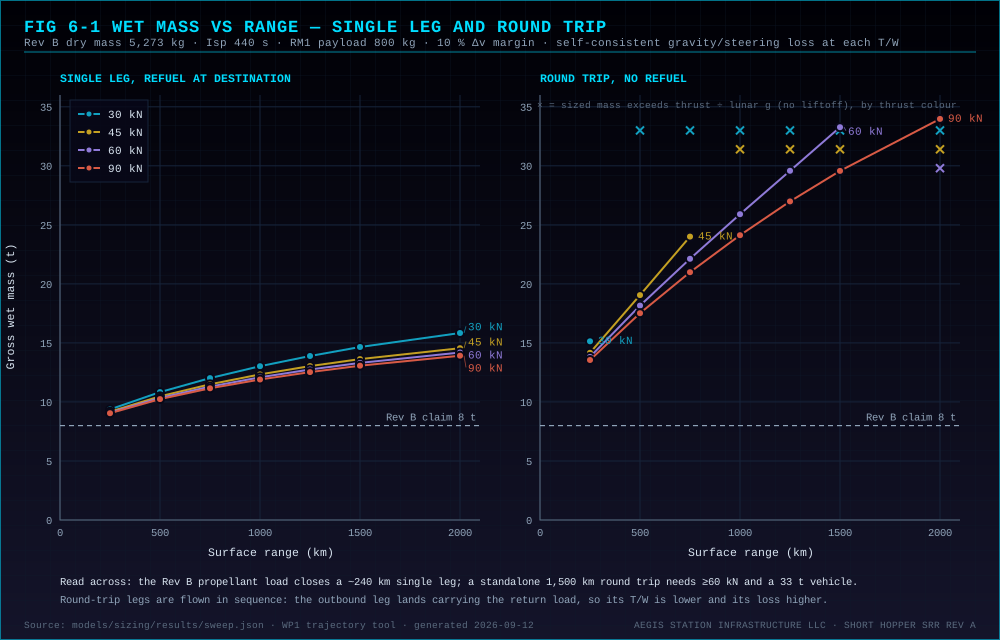
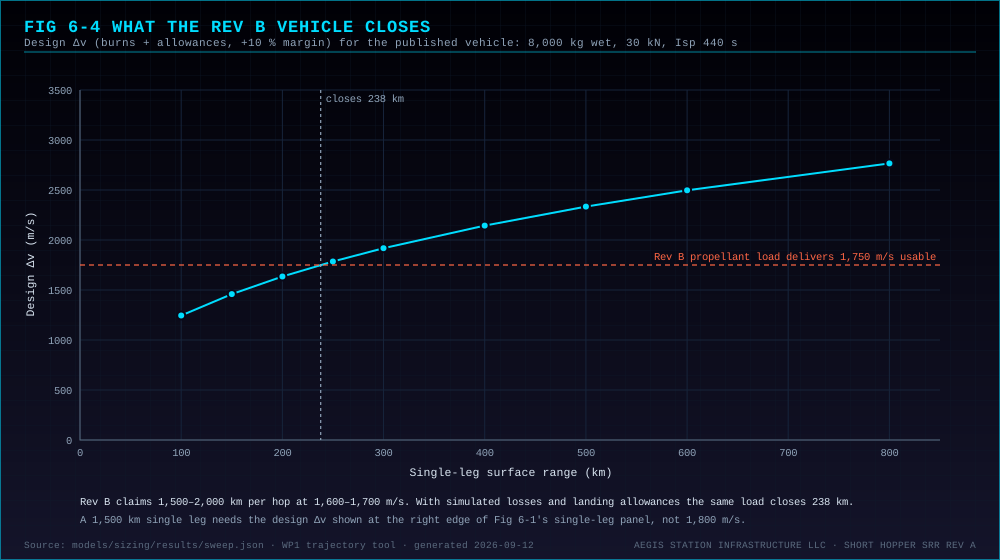
Rev C replaces the Rev B (Feb 2026) performance claims with the System Requirements Review Rev A baseline (Sep 2026), which is derived from a trajectory simulation validated against the Apollo 11 ascent and a linked budget model. The Rev B vehicle as published closes a 238 km single leg, not 1,500–2,000 km; the numbers below are the vehicle that closes the mission.
| // PHYSICAL | |
| TOTAL HEIGHT / LANDING ZONE | TBR — Rev B envelope (~6.5 m / ~4.5 m) predates the Rev C tank set |
| GROSS WET MASS | 18,160 kg (full load, 500 km round trip) |
| DRY MASS | 5,273 kg (Rev B allocation carried, TBR) |
| PROPELLANT MASS | 12,088 kg (66.6% mass fraction) |
| PAYLOAD, SIZING CASE | 800 kg — 2 crew + 500 kg cargo, carried on both legs |
| // PROPULSION | |
| PROPELLANTS | LOX / LH₂ (ISRU-compatible) |
| ENGINE CONFIG | Gimbaled cluster, engine-out capable — three ~20 kN engines recommended (trade open) |
| THRUST (VAC, TOTAL) | 60 kN |
| ISP (VACUUM) | 440 s nominal (430–450 s) |
| T/W AT LIFTOFF (LUNAR) | 2.0 at full load → increasing as propellant burns |
| DESIGN ΔV, ONE 500 km LEG | 2,244 m/s (burns + landing allowances, incl. 10% margin) |
| ΔV AT FULL TANKS | 4,727 m/s with the sizing payload aboard |
| ATTITUDE CONTROL | Engine gimbal (primary) + RCS thrusters (fine) |
| // PERFORMANCE | |
| SURFACE–SURFACE, BASELINE | 500 km round trip, no refuel at the remote site |
| SURFACE–SURFACE, GROWTH | 1,500 km one-way with LUNET refuel at destination — same tanks, no hardware change |
| SURFACE–LLO | 100 km LLO round trip, no orbital refuel, at 16,590 kg load (station era) |
| FLIGHT TIME, 500 km LEG | ~16 min liftoff to hover gate; apex ~104 km |
| REUSABILITY | Min. 10 sorties between intermediate service; wear items field-replaceable; core structure life 50 sorties to retirement (requirements, TBD) |
| TURNAROUND TIME | 24–48 hours at a LUNET node (requirement, TBD) |
| LANDING PRECISION | ±3 m with terrain-relative navigation (TBR) |
| // CREW & CARGO | |
| CREW (STANDARD) | 4 astronauts |
| CREW (MAX / REDUCED RANGE) | 6 astronauts |
| CARGO CAPACITY | Up to 1,000 kg (cargo config) |
| OPERATIONAL DURATION | 72–96 hours (crewed) |
| // SYSTEMS | |
| AVIONICS | Dual-redundant radiation-hardened flight computers |
| NAVIGATION | FOG/RLG IMU + MEMS backup, Kalman fusion, lidar/radar alt. |
| LANDING GUIDANCE | Terrain-relative nav; LUNET beacon alignment compatible |
| COMMS | S-band/UHF (short range) + high-gain directional (station uplink) |
| POWER | Rechargeable battery packs + passive solar backup |
| LIFE SUPPORT | O₂/N₂ pressurized cabin; Orion-class LSS heritage |
| DOCKING INTERFACE | Aft/lower hatch; soft-seal pressurized collar |
| FLIGHT SOFTWARE | NASA cFS stack, ten mission applications, 13-phase autonomy executive (aegis-hopper-fsw 2.0) |
- Four fixed legs, thermal-shielded with adaptive dust-tolerant footpads
- Terrain-relative navigation via lidar + radar altimeter
- FOG or RLG IMU with MEMS backup; Kalman sensor fusion
- LUNET beacon alignment for node-assisted precision landing
- Nominal precision: ±3 m; abort-to-pad, abort-to-surface and abort-to-orbit modes defined; engine-out on descent is designed out by the cluster
- Operable in permanently shadowed regions (PSRs)
- Soft-docking collar: compatible with Aegis Station, surface habs, Aegis-Class Rover suitport
- Pressurized telescoping tunnel with dust seals — no EVA required for crew transfer
- Cryogenic refueling via LUNET-compatible cartridge port
- Palletized cargo latch-and-lock; optional robotic assist arm
- Field diagnostics via rover interface or LUNET node
- Modular avionics and structural interfaces for rapid field swap
| // SERVICE TIERS (SRR §2.8, REQUIREMENTS TBD) | |
| 1 — LINE SERVICE | Every sortie, inside the 48 h turnaround, at the home node. Telemetry and cycle-counter review, leak check on refuel, camera inspection of gear and underside, sensor-window cleaning, consumables and RCS reload. No planned hands-on work. |
| 2 — INTERMEDIATE | On counters or on condition, not more often than every 10 sorties. EVA crew or rover arm, no pressurised facility. Engine inspection or swap, footpad and damper replacement, seal replacement, sensor recalibration, insulation inspection. |
| 3 — RETIREMENT | Tanks, structure and pressure vessel at their certified life, 50 sorties (200 burns, 300 starts, 100 landings), to be reviewed against dust and ejecta erosion data. Credible on cycles: reusable boosters already exceed 20 flights. Pre-station the vehicle is retired in place; station-era return to an orbital facility is a growth option, not a dependency. |
Artemis puts boots on the surface. CLPS puts instruments on the ground. ISRU demonstration missions prove you can make propellant. What's missing is the vehicle that ties all of it together — a reusable, refuelable shuttle that can move crew and cargo between any two points on the Moon and back to orbit, on a schedule, without a new launch from Earth every time.
The Short Hopper is designed to fill that gap. It turns surface sites into connected nodes rather than isolated flags-and-footprints destinations. It converts ISRU propellant into operational reach. And it gives a lunar orbital station — Aegis or otherwise — a reason to exist as a logistics hub rather than an end unto itself.
A vehicle like this doesn't get built by one company. It requires the kind of sustained investment and technical depth that comes from NASA program involvement and major aerospace partners working toward a shared architecture. What Aegis Station Infrastructure brings is a System Requirements Review baseline that says what closes and what does not: reference missions with simulated trajectories, a linked budget that reproduces the simulation, requirements with sources, trade studies with numbers, a risk register, and a flight-software stack already flying the mission profile in simulation. The open decisions — baseline range, one vehicle or two, engine count — are stated as open. That is the part we bring to the table.