LUNET
A standardized infrastructure for lunar mobility and ISRU integration
The Lunar Utility Node & Exchange Terminal (LUNET) is a standardized network of surface and orbital utility nodes designed to support routine, repeatable lunar transportation and operations. LUNET enables refueling, recharging, diagnostics, and logistics coordination for lunar surface and cislunar vehicles.
Rather than treating lunar mobility as a sequence of bespoke missions, LUNET establishes persistent infrastructure. It allows vehicles to carry only the propellant required for the next leg, enabling low-delta-v hops between nodes and supporting sustained operational cadence.
System Characteristics
- Distributed surface and orbital utility nodes
- Refueling, recharging, diagnostics, and logistics exchange
- Designed for integration with lunar and orbital ISRU pipelines
- Independent of any single vehicle or station architecture
- Scalable from initial pathfinder nodes to full network coverage
ISRU-Aligned Operations
LUNET is designed around a water-buffered ISRU architecture. Water absorbs uncertainty and provides long-duration buffering, oxygen naturally lends itself to inventory, and hydrogen is treated as a short-dwell, near-use commodity rather than a bulk storage product.
This approach reduces power burden, tank mass, and system brittleness while improving operational resilience and scalability.
Water as the Network Commodity
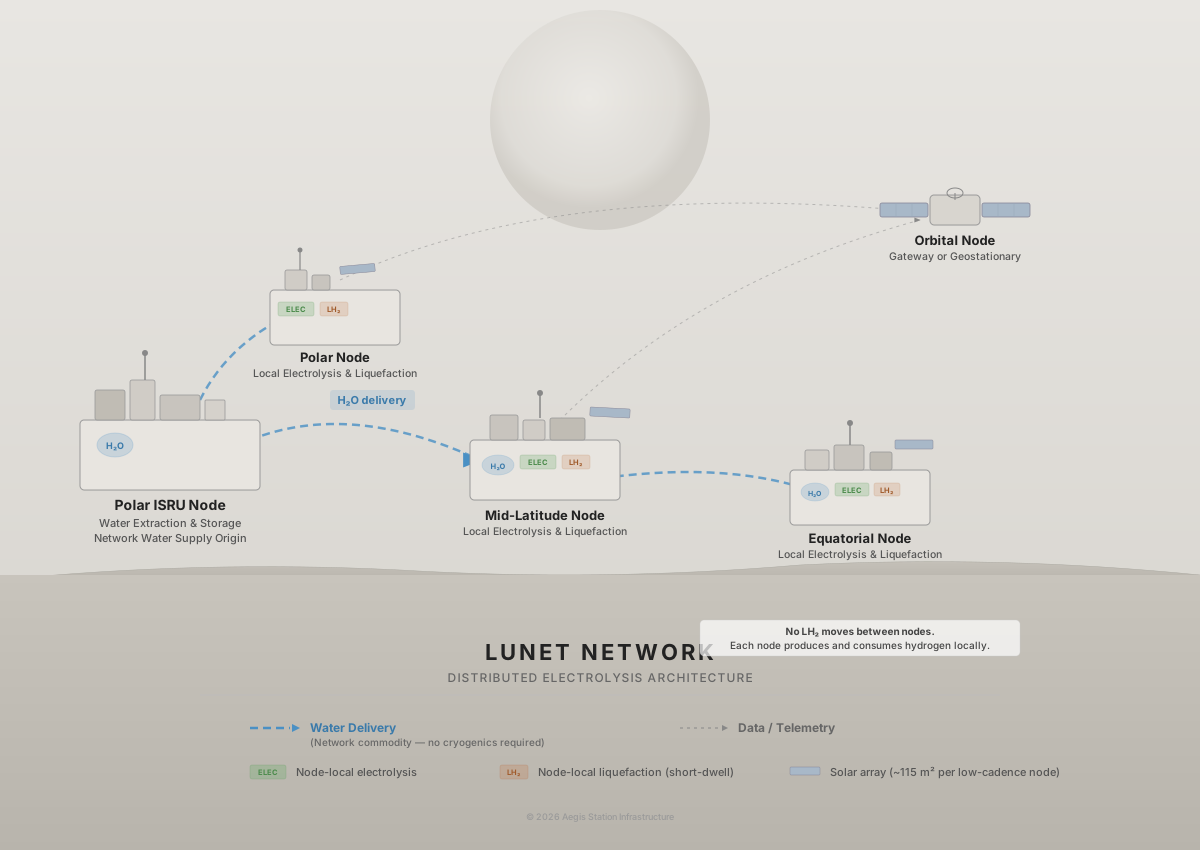
A central architectural decision in LUNET is that water—not liquid hydrogen—is the commodity that moves through the network. Each node receives water deliveries and performs electrolysis and liquefaction locally. This converts a network-scale cryogenic logistics problem into a contained, node-local equipment problem.
Water is the ideal transport commodity for lunar infrastructure: indefinitely stable with no boil-off, requiring no cryogenic insulation or vacuum-jacketed transfer lines, compatible with standard elastomeric seals and simple disconnectable fittings, storable in rigid tanks or flexible bladders, useful as radiation shielding while in storage, and presenting no explosion hazard.
Hydrogen Infrastructure Philosophy
Liquid hydrogen (LH2) presents unique infrastructure challenges at every stage: storage, transfer, and consumption. LUNET's architecture is designed around these constraints rather than attempting to overcome them through brute-force engineering.
Why Hydrogen Is Short-Dwell
The short-dwell principle is driven not only by boil-off losses but by the cumulative degradation of transfer infrastructure itself. LH2 transfer lines degrade through thermal cycling fatigue (every fill/drain cycle between ambient and 20 K accumulates damage in bellows, flex joints, and bayonet connections), progressive hydrogen embrittlement at welds and heat-affected zones, vacuum jacket degradation as getter materials saturate and micro-leaks develop, and seal wear as PTFE cold-flows and spring-energized seals lose preload.
On the lunar surface, replacing transfer lines is a major operation: warming, purging, joint breaking, seal replacement, leak checking, vacuum jacket re-evacuation, and re-cooling. The fewer times LH2 is moved, and the shorter the dwell, the less infrastructure burden the network carries.
Produce Near, Consume Fast
Each LUNET node electrolyzes water and produces LH2 locally, with a short cryogenic path from electrolyzer to liquefier to fill coupling—typically a few meters of plumbing. This is a fundamental differentiator from depot-centric architectures that assume bulk LH2 movement across the lunar surface.
Node Design Implications
- Co-locate electrolyzer, liquefier, and fill coupling with the shortest practical plumbing run
- Design fill interfaces for minimum disconnect cycles—direct fill from on-site production
- Stock seal consumables (indium gaskets, PTFE seal kits, spring-energized seal replacements) as standard logistics items
- Redundant fill lines at high-traffic nodes to avoid single-point failures
- Boil-off monitoring as standard node health telemetry
- Electrolyzer membrane spares as a planned maintenance item (PEM membranes: thousands of hours lifespan)
Node-Level Electrolysis and Power
PEM (proton exchange membrane) electrolyzers are inherently modular, commercially available from single-kilowatt to megawatt scale with identical core stack architecture. A LUNET node filling a rover with a few hundred kilograms of propellant between hops requires capacity on the order of a few kilowatts to approximately 20 kW—well within demonstrated hardware scale. Solid oxide electrolysis (SOEC) offers higher efficiency at high operating temperatures, potentially advantageous when co-located with thermal management systems.
Power Sizing Reference
Total node power requirements for the hydrogen production chain (electrolysis plus liquefaction) at different operational cadences, assuming a reference fill of 100 kg LH2 per vehicle:
| Fill Interval | Electrolysis | Liquefaction | Total Power |
|---|---|---|---|
| 14 days (1 per lunar day) | ~16 kW | ~7 kW | ~23 kW |
| 3 days | ~75 kW | ~35 kW | ~110 kW |
| Daily fills | ~230 kW | ~104 kW | ~334 kW |
Solar Array Sizing
Mid-latitude sites deliver approximately 200–250 W/m² from solar arrays (accounting for panel efficiency, packing factor, and dust degradation). Daytime-only production:
| Fill Interval | Power Required | Array Area | Approximate Size |
|---|---|---|---|
| 14 days | ~23 kW | ~115 m² | ~10 m × 12 m |
| 3 days | ~110 kW | ~550 m² | ~23 m × 24 m |
| Daily fills | ~334 kW | ~1,670 m² | ~40 m × 42 m |
A low-cadence node—serving a hopper every couple of weeks—runs its entire hydrogen production chain from roughly 115 m² of solar array, deployable from a single lander. As traffic grows, panels are added incrementally. The architecture scales linearly with demand.
Gaseous Hydrogen Alternative
Gaseous hydrogen propulsion eliminates the entire liquefaction chain at a specific impulse penalty of approximately 10–15%. For short surface hops between LUNET nodes, this trade may close favorably: slightly more propellant per hop in exchange for dramatically simpler and more reliable node infrastructure.
Resupply and Logistics
With node-level electrolysis and liquefaction, LUNET resupply simplifies to water delivery (from polar ISRU or Earth as backup, via simple unpressurized rovers and hoppers) plus maintenance consumables (electrolyzer membranes, cryogenic seal kits, power system maintenance items). These are compact, shelf-stable items that can be stockpiled.
This converts the hardest problem in lunar propellant logistics—moving and storing liquid hydrogen—into the easiest one: moving and storing water.
Strategic Role
By decoupling vehicles from mission-complete propellant loads and enabling staged exchange across persistent nodes, LUNET transforms lunar ISRU from demonstration into daily operations that can be planned, relied upon, and scaled. Its distributed architecture is fundamentally more compatible with liquid hydrogen's constraints than a centralized depot model, requiring no long-distance cryogenic transfer lines and enabling incremental growth as traffic demands.