Aegis Station — Transportation & Logistics
Pre-station infrastructure that decouples propellant availability from Earth launch timing. Water in. Methalox out. Operational before the station ring is assembled.
Every other element of the Aegis logistics chain — the Long-Hauler, the Lunar Tanker Fleet, eventually the station itself — depends on propellant being available in lunar orbit. Without a depot, each Hauler mission must carry enough propellant for a complete round trip from Earth, and each Tanker cycle is constrained by whatever propellant it can produce and carry from the surface alone.
The LOPD breaks both constraints. Once operational, the Hauler arrives at the depot, offloads LCH₄, refuels its return burn from depot-produced LOX, and departs. The Tanker fleet tops off between cycles rather than carrying full reserves on every ascent. The depot absorbs production variability from the surface and smooths it into a stable supply available on demand.
The depot's pressurized node also gives the program its first shirt-sleeve presence in lunar orbit — a maintenance-accessible, crew-visitable outpost — before the station ring is ever assembled. It is the beachhead.
The depot operates two parallel input streams that converge into a single methalox output. LOX is produced locally from water. Methane is imported. Both are stored cryogenically and dispensed on demand.
Water moves through the Aegis logistics chain in standardized cartridges — a fixed hardware unit that functions as both a transport vessel and a depot storage element. The cartridge is the atomic unit of the water supply chain: manufactured on Earth, delivered to the lunar surface, filled by ISRU operations, and flown to the depot by the Lunar Tanker Fleet.
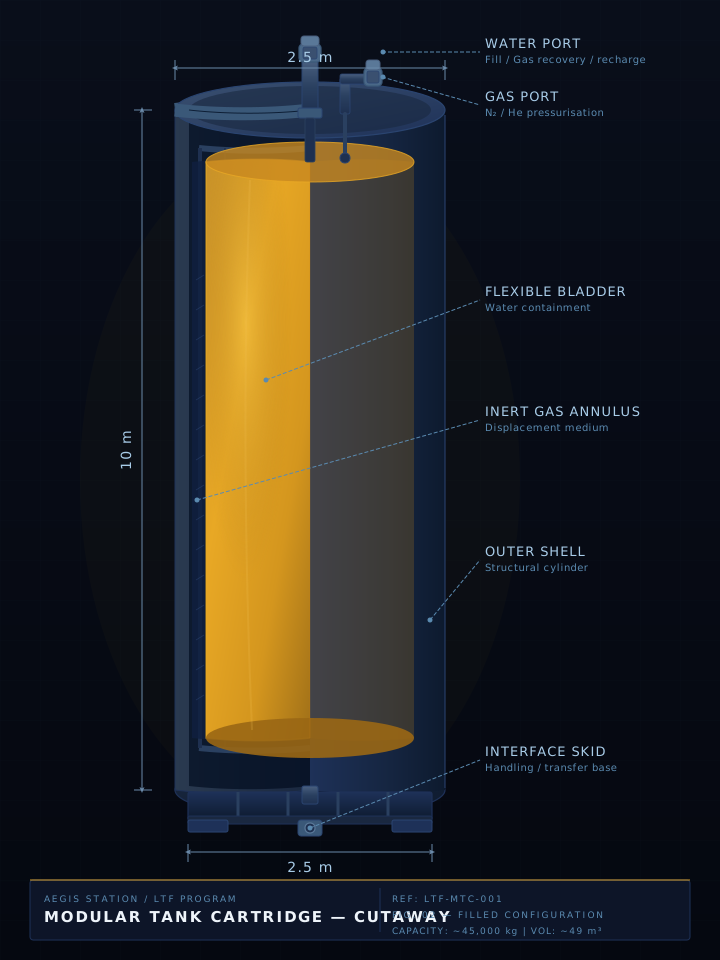
Length: 10 m
Diameter: 2.5 m
Gross interior volume: ~49 m³
Full mass: 45 t
Dry mass: TBD
Interior inflatable/deflatable bladder contained within the outer structural cylinder. Bladder collapses fully when empty — cartridge ships to the surface as a lightweight structural shell and returns to orbit full. Single-use fill cycle per mission is the baseline; reuse cadence TBD pending durability analysis.
Sized to fit within Falcon Heavy and New Glenn payload envelopes for Earth launch. Hauler freight module accommodates multiple cartridges per transit. Standardized docking and fluid transfer interfaces common across depot, LT fleet, and surface infrastructure.
Dry mass not yet defined — drives launch manifest economics and LT payload fraction. Bladder material selection pending thermal, radiation, and reuse requirements. Cartridges-per-Hauler transit TBD pending Hauler freight module configuration. Total cartridge fleet size TBD pending ISRU cadence and depot storage requirements.
The inflatable bladder approach keeps empty cartridge mass low — the structural cylinder is essentially dead weight on the outbound trip to the surface. Minimizing dry mass is the dominant design driver: every kilogram of cartridge structure launched from Earth is a kilogram that isn't water.
The first water to reach the depot comes from Earth. This is the most expensive water in the program — and everyone involved knows it. The economic case for Aegis Station does not depend on Earth-sourced water being cheap. It depends on Earth-sourced water being finite: a necessary cost to establish the infrastructure that makes lunar-sourced water viable at scale.
A 45 t full cartridge is close to the maximum payload capacity of the vehicles that can lift it. Falcon Heavy (expendable) delivers ~64 t to LEO; New Glenn delivers ~45 t to LEO. A single loaded cartridge consumes the majority of one heavy-lift mission — before accounting for the transfer stage cost to get from LEO to lunar orbit.
This is not a problem to be solved — it is a phase to be survived. The early program accepts high water costs as the price of establishing the depot, proving the end-to-end system, and reaching the crossover point where lunar ISRU becomes the cheaper source.
Hauler delivers empty cartridges, depot hardware, and LCH₄ to lunar orbit. No water production yet. Depot is assembled and commissioned. Cartridges are staged on the surface, ready for ISRU fill. Cost per kilogram of water: not yet relevant — there is no water.
A small number of Earth-water-filled cartridges ride the Hauler to prime the electrolysis plant and commission end-to-end propellant production. Expensive but finite — this is a one-time commissioning cost, not a sustained supply model. ISRU operations beginning on the surface in parallel.
Lunar Tanker Fleet begins delivering surface-produced water. Earth water imports taper and stop as LT cadence ramps. Cost per kilogram of depot water begins its long decline. The crossover point — where lunar water is cheaper than Earth water delivered — is the program's most important economic threshold.
Depot runs on lunar water exclusively. Earth imports limited to LCH₄ and non-water consumables. Propellant production cost is dominated by LT operations and electrolysis power, not launch costs. Economic model is viable at scale.
Starship changes the calculus significantly — and in a non-obvious direction. At projected full-reuse economics, Starship could potentially deliver 2–3 loaded cartridges per mission to LEO, dramatically reducing the per-kilogram cost of Earth-launched water. This does not make Earth water cheap enough to sustain the depot indefinitely, but it does move the crossover point — potentially making it economically rational to run on Earth water longer than the current heavy-lift cost structure would suggest.
The program should not plan around Starship economics, but should track them. If launch costs fall far enough fast enough, the ISRU investment timeline and urgency changes. Architecture decisions that assume expensive Earth water baked in as a permanent condition may need revisiting as the launch market evolves.
The total volume of Earth-sourced water required to prime the depot and commission the electrolysis plant has not yet been calculated. This is a program-level open item. It drives the number of Hauler missions in Phase 2, the commissioning timeline, and the initial capital cost of reaching operational status. Resolving this trade is a prerequisite for program-level cost estimation.
Active cryo cooling to suppress boiloff in both LOX and LCH₄ tanks. Zero-boiloff (ZBO) target for long-duration storage windows between Hauler arrivals. Thermal isolation, multilayer insulation, and controlled venting provisions. Heat rejection to space via dedicated radiator panels.
Electrolysis, storage monitoring, and propellant transfer all operate without crew present. Fault detection, isolation, and recovery (FDIR) logic handles off-nominal states autonomously. Remote telemetry and commanding via ground or Aegis Station once operational. Safe-mode and pressurization safing on loss of comms.
Pressurized node supporting maintenance visits of several days. Life support, crew berthing, and basic EVA prep provisions. Not a long-duration habitat — crew presence is for servicing, inspection, and system resets, not extended operations.
Multiple docking ports sized for Hauler and LT approach geometries. Pressurized crew transfer compatible with Hauler and Shuttle. Unpressurized cargo and propellant transfer via standardized cryo fluid couplings. Robotic berthing provisions for cargo handling without EVA.
Solar arrays sized to drive continuous electrolysis operations as the primary load. Battery storage for eclipse periods and surge demand. Electrolysis power draw is the dominant sizing driver — depot power budget is essentially an electrolysis power budget with margin.
Modular architecture with discrete functional nodes — electrolysis module, cryo storage modules, crew node, docking adapter ring. Each module launchable and assembled on-orbit or pre-integrated for single-launch delivery. Interface design supports future incorporation into Aegis Station without redesign.
The depot is a service node. Its design is downstream of the vehicles it serves.
Interface Control Documents (ICDs) between the LOPD and each vehicle are a program-level deliverable. The depot's physical and operational interfaces must be locked before any vehicle finalizes its docking or propellant transfer system design.
The depot's relationship to Aegis Station is intentionally left open. Two futures are both valid, and the architecture is designed not to force a choice prematurely.
Depot modules incorporate into the Aegis Station architecture as the station assembles around them. The cryo storage, electrolysis plant, and docking infrastructure become station subsystems. The depot becomes the propellant and logistics hub of the completed station.
Depot remains an independent node in lunar orbit alongside Aegis Station. Provides redundancy, overflow capacity, and a separate operational asset. Useful if depot orbit and station orbit differ, or if program growth warrants two nodes.
The modular interface design ensures both options remain available without redesign. Program-level architecture authority holds the decision until the tradeoffs are sufficiently resolved.